How can I objectively evaluate a pool project without relying on a single average figure?
Calculate five metrics from figures the contractor should already provide: turnover time (volume ÷ pump flow), filtration rate (flow ÷ filter bed area), surge tank ratio (8-12% of volume for overflow pools), cost line share (line price ÷ total quote), and expected daily water loss (surface area × 5-12 mm). Each has a known target range you can check your project against.
There Is No "Average" Pool Company, Only a Measurable Project
A single average number — average build time, average cost, average water loss — collapses projects with completely different sizes, soil conditions, and equipment classes into one misleading figure. What actually helps is a method: formulas you can apply to your own project's real inputs to get a number that means something.
The five metrics below are built entirely from figures already established across our engineering guides and calculators — nothing here is a new, unverifiable statistic.
5 Metrics You Can Calculate Yourself
1. Turnover Time
Turnover Time (hours) = Pool Volume (m³) ÷ Pump Flow Rate Q (m³/h)
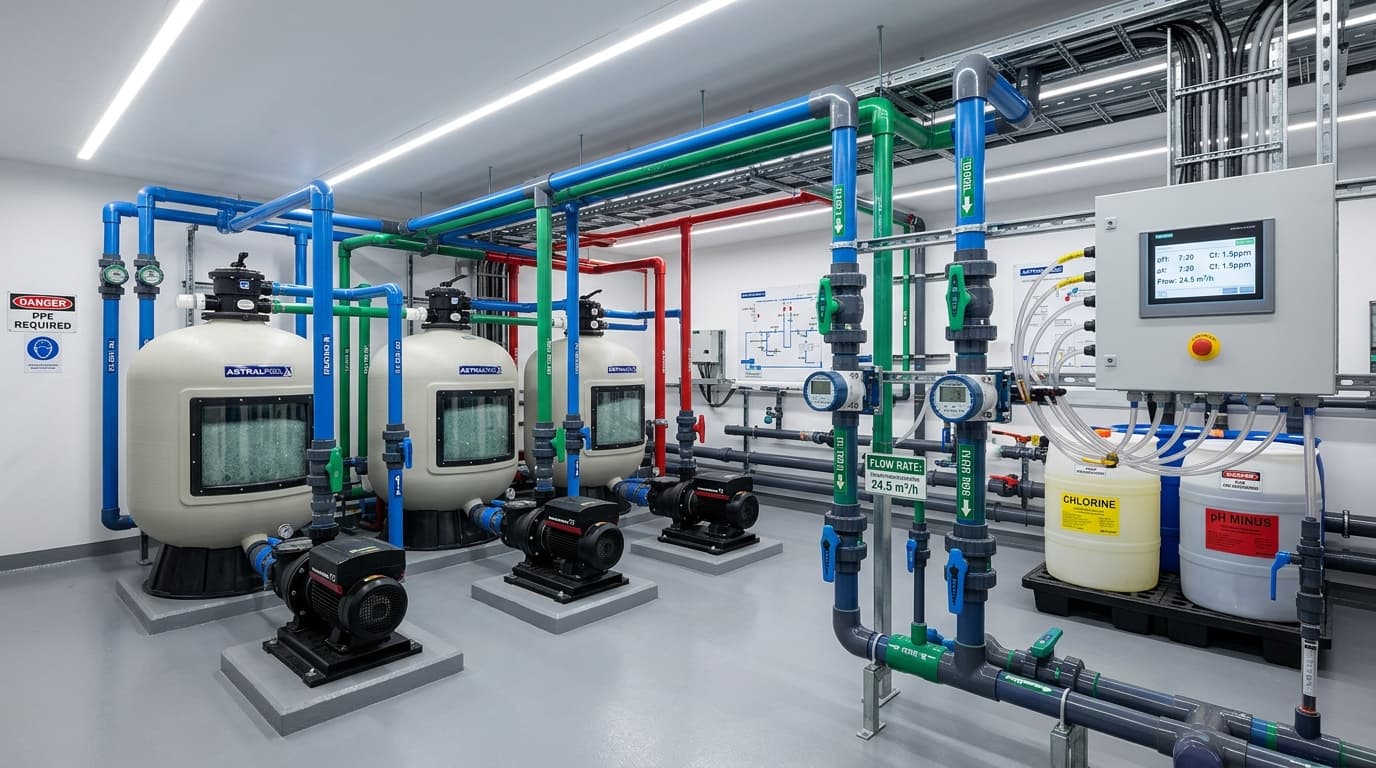
Under TS 13661 the target range varies by pool type: roughly 4 hours for competition/public pools, 6-8 hours for private residential pools, 1-2 hours for children's pools. Divide the pump flow rate a contractor proposes by your pool's volume to verify yourself whether the quote falls within this range.
See TS 13661 Detail →2. Filtration Rate
Filtration Rate (m/h) = Flow Rate (m³/h) ÷ Filter Bed Area (m²)
The target for high-grade filtration is 20-30 m/h, with up to 50 m/h acceptable for private pools. Confirm the specified filter model's bed area with the manufacturer and run this formula yourself.
3. Surge Tank Ratio
Surge Tank Volume = 8%–12% of Pool Volume (for overflow/infinity pools)
This ratio derives from the sum of bather displacement (~75 liters per person), wave overflow (10-20 liters per m²), and the backwash reserve. Divide the proposed surge tank volume by your pool volume to check the percentage yourself.
See Surge Tank Calculation →4. Cost Line Share
Line Item Share (%) = Line Item Price ÷ Total Quote × 100
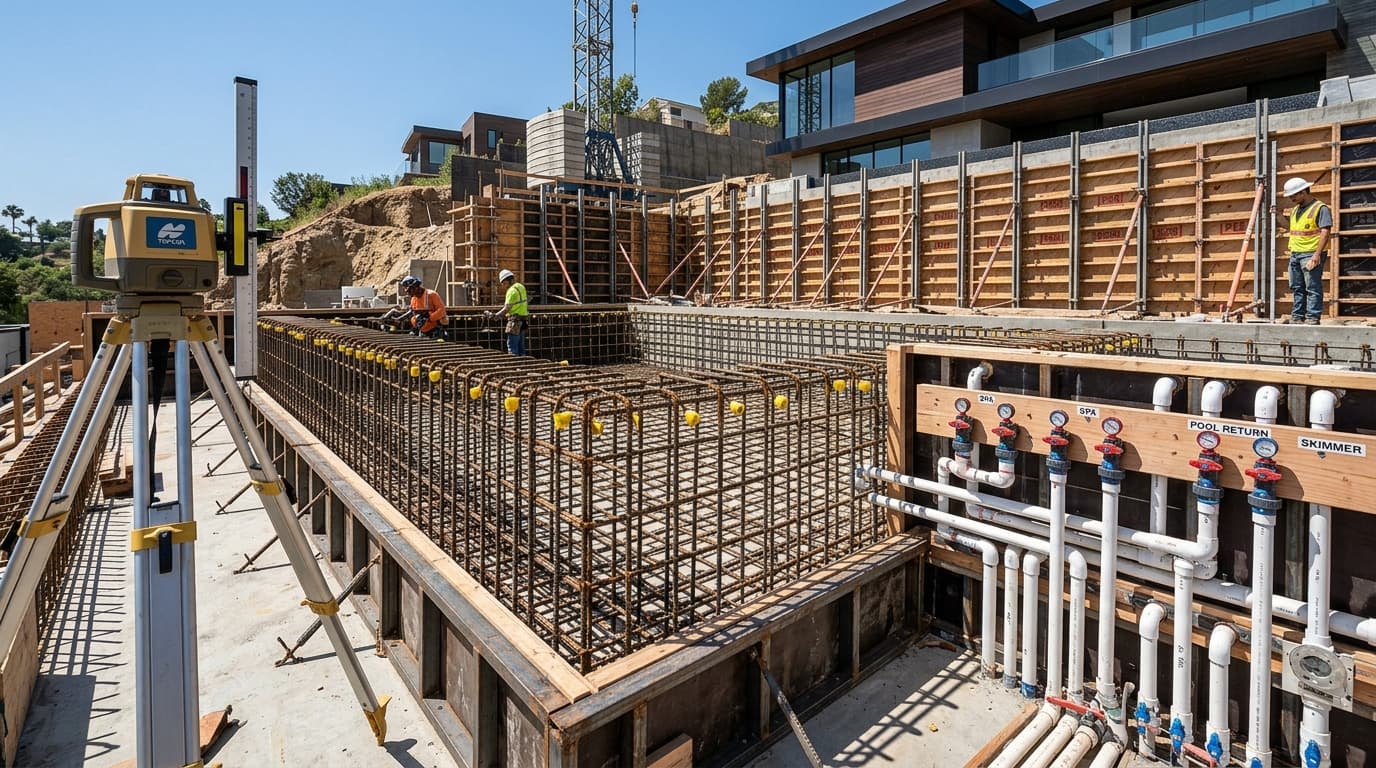
The concrete structure typically carries the largest single share, while waterproofing is a small share with disproportionately high repair cost if it fails. With an itemized quote, use this formula to see exactly what portion of the total each line item represents.
See Cost Line Distribution →5. Daily Water Loss Rate
Expected Evaporation (L/day) = Surface Area (m²) × 5-12 mm/day
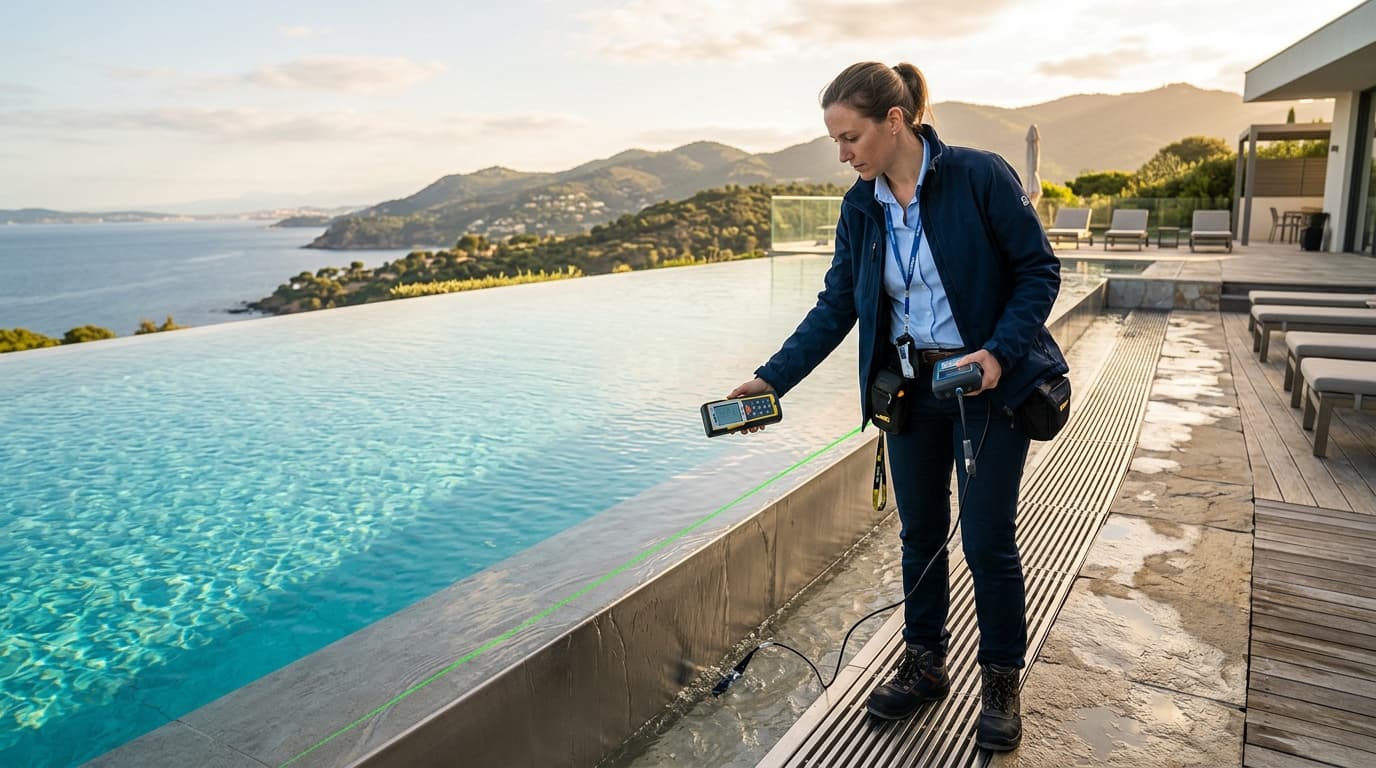
Normal summer evaporation falls in the 5-12 mm/day range; for a 100 m² outdoor pool, that's 500-1,200 liters per day. If your measured water loss is clearly above this range, the Bucket Test can isolate a possible structural leak from ordinary evaporation.
Open the Water Loss Calculator →How to Apply This to a Quote
Ask for the raw inputs — pump flow rate, filter bed area, surge tank volume, itemized cost lines — rather than the finished conclusion. A contractor confident in its numbers will hand these over without hesitation; you then run the formulas above yourself, using your own pool's volume and surface area.
Conclusion
A pool project is either sized through calculation or it isn't — and calculation produces numbers you can check independently. These five formulas turn evaluation from a matter of trust into a matter of arithmetic.
Frequently Asked Questions
Why publish a method instead of average cost or timeline figures?+
Because an "average" across pools of different sizes, soil conditions, and equipment classes is not a meaningful number for any single project — it would either mislead you or require so many caveats it stops being useful. A formula you can apply to your own project's actual parameters gives a more honest answer than a single averaged figure.
Can I use these formulas without an engineering background?+
Yes — each formula here uses only figures a contractor should already be providing (pump flow rate, filter bed area, quote line items) divided by numbers you already have (pool volume, surface area). The goal is to let you check a quote's numbers, not to replace a full hydraulic/structural calculation.
What if a contractor can't give me the numbers these formulas need?+
That is itself informative — pump flow rate, filter bed area, and an itemized quote are basic outputs of a project-specific hydraulic calculation. If a contractor can't provide them, the project likely wasn't sized through calculation in the first place.
Get Your Own Numbers Calculated
Request a hydraulic pre-evaluation using your project's actual parameters — no obligation.