
Explore our full product range, project applications, and service areas in detail through our E-Catalogue. Our engineering-led solutions and internationally certified services are presented in this comprehensive reference document.
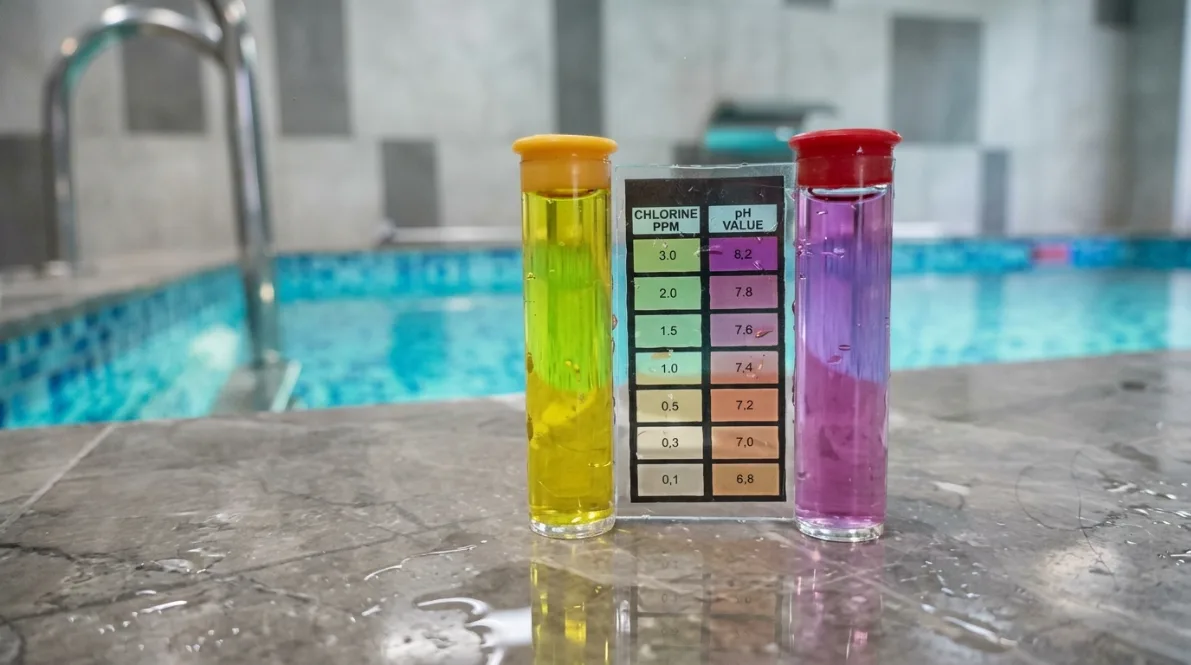
Calculate chlorine, pH balance, algaecide, and monthly chemical consumption schedules tailored to your pool volume in seconds.
Accurate chemical dosing not only ensures crystal-clear, hygienic water but also preserves equipment integrity. Use the tables and interactive calculator below to plan initial start-up, routine upkeep, and seasonal inventory needs.
Swimming pool sanitation requires maintaining pH between 7.2 and 7.6, free chlorine between 1.0 and 3.0 ppm (commercial) or 0.5 and 1.5 ppm (private), total alkalinity at 80 to 120 ppm, cyanuric acid stabilizer under 50 ppm, and a Langelier Saturation Index (LSI) within -0.3 to +0.3.
Calculate the initial shock chlorine, pH stabilizer, algaecide, and clarifier dosages required when filling or commissioning the pool, ensuring optimal baseline water parameters.
Maintain crystal-clear, sanitized water through automated or manual daily chlorine dosing alongside weekly algaecide and flocculant applications calibrated to pool capacity.
Plan procurement across 30-day or multi-month intervals with itemized packaging breakdowns (canisters, containers, drums) to simplify inventory management and budgeting.
Enter your pool volume to compute shock, maintenance, and monthly consumption schedules.
Initial Fill Shock: 4.74 kg
0,00 kg
Initial Fill Shock Chlorine (12%)
pH Reducer: 0,00 - 0,00 kg
0,00 kg
Daily Maintenance Chlorine
Powder Cl: 0,00 - 0,00 kg/day
Swimming pool water balance must comply with technical and health authority standards. Below are the statutory benchmark parameters and a quick volume-based dosing reference.
| Parameter | Ideal Range | Unit | Technical & Health Impact |
|---|---|---|---|
| pH Level | 7.2 – 7.6 | pH Scale | Low causes corrosion & eye irritation; high causes scale & chlorination failure |
| Free Chlorine (Outdoor) | 1.0 – 3.0 | ppm (mg/L) | Primary sanitizer baseline for full biological pathogen inactivation |
| Free Chlorine (Indoor) | 1.0 – 1.5 | ppm (mg/L) | Restricted to minimize chloramine buildup and air quality issues |
| Combined Chlorine | Max 0.2 | ppm (mg/L) | Indicates chloramine presence; values >0.2 require immediate shock dosing |
| Total Alkalinity (TA) | 80 – 120 | ppm CaCO3 | Buffers pH against abrupt fluctuations from bather load and rainfall |
| Cyanuric Acid (Stabilizer) | 20 – 50 | ppm (mg/L) | Shields free chlorine from UV degradation; values >100 ppm cause chlorine lock |
Standard average daily and monthly chemical consumption benchmarks across typical pool capacities:
| Pool Volume / Type | Daily Chlorine | Daily pH Reducer | Weekly Algaecide | Monthly Estimated Total |
|---|---|---|---|---|
| 50 m³ (Residential / Villa) | 100 - 150 g | 150 - 250 g | 250 - 500 ml | 3.5 - 5 kg Chlorine / 5 - 8 kg pH- |
| 100 m³ (Community / Medium) | 200 - 300 g | 300 - 500 g | 500 - 1000 ml | 7 - 10 kg Chlorine / 10 - 15 kg pH- |
| 250 m³ (Large Complex / Hotel) | 500 - 750 g | 800 - 1250 g | 1.5 - 2.5 L | 18 - 25 kg Chlorine / 25 - 40 kg pH- |
| 500 m³ (Semi-Olympic / Resort) | 1000 - 1500 g | 1.5 - 2.5 kg | 3 - 5 L | 35 - 50 kg Chlorine / 50 - 80 kg pH- |
Follow this engineering sequence to ensure optimal chemical performance, prevent equipment scaling, and keep pool water pristine.
pH is the foundational parameter of pool water chemistry. Sanitizers operate at peak efficacy only when pH is calibrated within 7.2 to 7.6. Administer pH minus (dry acid / sodium bisulfate) or pH plus as indicated by test readings.
Principle: Chlorine sanitizing power drops by up to 80% when water pH exceeds 7.8.
Perform shock chlorination (10-15 g/m³ of 56% stabilized granular chlorine) at commissioning or post-algae bloom. For daily upkeep, maintain free available chlorine between 1.0 and 3.0 ppm via continuous or daily dosing.
Principle: Always dose chlorine during evening hours to avoid immediate solar UV degradation.
Apply non-foaming algaecide weekly to inhibit spores before colonization. If active algae are present, shock chlorinate and brush pool surfaces thoroughly prior to algaecide addition.
Principle: Never dose algaecide simultaneously with shock chlorine; allow 2-3 hours of filtration between applications.
Use liquid coagulants or clarifiers to agglomerate sub-micron colloidal turbidity that bypasses sand beds. Run continuous circulation for 6-8 hours, allow settling, and vacuum to waste.
Principle: In cartridge-based filtration systems, use dedicated liquid clarifiers instead of heavy aluminum sulphate flocculants.
Different chlorine compounds produce distinct impacts on water pH, cyanuric acid levels, and operational costs. Use our technical breakdown to choose the exact sanitizer for your installation.
| Chlorine Type / Compound | Active Cl Ratio | pH Impact | Stabilizer (CYA) Impact | Optimal Application |
|---|---|---|---|---|
| 56% Granular Chlorine (Sodium Dichloroisocyanurate) | 56% Available Chlorine | Near Neutral (pH ~6.7) - Minimal pH impact | Contains stabilizer (~0.9 ppm CYA per 1 ppm Cl) | Fast-dissolving, ideal for shock dosing and daily upkeep |
| 90% Tablet / Granular Chlorine (Trichloroisocyanuric Acid) | 90% Available Chlorine | Strongly Acidic (pH ~2.8) - Depresses pH over time | High stabilizer content (~0.6 ppm CYA per 1 ppm Cl) | Slow-release erosion dosing in skimmers and in-line feeders |
| Liquid Chlorine (Sodium Hypochlorite 12-15%) | 12% – 15% Available Chlorine | Highly Alkaline (pH ~11-13) - Drives pH upward | Zero Cyanuric Acid (Will NOT cause chlorine lock) | Automated peristaltic dosing pumps in commercial facilities |
| Calcium Hypochlorite (65-70% Cal-Hypo) | 65% – 70% Available Chlorine | Alkaline (pH ~11.8) - Increases calcium hardness | Zero Cyanuric Acid (Stabilizer-free) | Rapid unstabilized shock chlorination for heavy bather loads |
Pool water is in perfect equilibrium when it neither dissolves pool surfaces nor precipitates calcium scale. The Langelier Saturation Index (LSI) is the international engineering standard to verify true saturation.
Where TF = Temperature Factor, CF = Calcium Hardness Factor, AF = Alkalinity Factor, Constant = 12.1 (for TDS < 1000 ppm)
Attacks plaster, grouting, and metallic pump/heater components.
Perfect balance. Maximum bather comfort and equipment lifespan.
Causes cloudy water, clogged filters, and calcium crust on tiles.
Logarithmic scale of acidity/basicity. The most sensitive driver in the LSI equation.
Warmer water accelerates calcium precipitation, shifting the LSI toward scale-forming territory.
Measures dissolved calcium carbonate. Optimal equilibrium is maintained between 200 - 400 ppm.
Buffers water against rapid pH swings; statutory benchmark is 80 - 120 ppm as CaCO3.
Represents overall ionic strength and mineral salinity offsetting the constant term (12.1).
Water chemistry imbalances can result in cloudy water, eye stinging, or scale buildup. Use our diagnostic guide to troubleshoot and restore water balance.
Contrary to common belief, this is caused by combined chlorine (chloramines) due to insufficient free chlorine rather than excess chlorine.
Perform breakpoint shock chlorination at 10x the combined chlorine level to oxidize chloramines, followed by filter backwashing.
High pH (>7.8), excessive alkalinity, inadequate filtration run-time, or unfilterable colloidal suspended solids.
Lower pH to 7.2 - 7.4 with dry acid, add liquid clarifier or coagulant, and operate filtration continuously for 24 hours.
Low free available chlorine (<1.0 ppm), high water temperature, stabilizer over-saturation, or poor hydraulic dead zones.
Shock treat with unstabilized chlorine, brush all surfaces aggressively, dose broad-spectrum algaecide, and vacuum settled debris to waste.
Excessive calcium hardness (>400 ppm) paired with elevated pH and total alkalinity (Positive Langelier Saturation Index).
Partially dilute pool volume with fresh soft water, stabilize pH strictly at 7.2, and introduce scale inhibitor sequestering agents.
Continuous use of stabilized isocyanurates (trichlor/dichlor) accumulating cyanuric acid beyond 100 ppm.
Cyanuric acid cannot be chemically removed; drain 30% to 50% of the pool volume and refill with fresh municipal water.
Excessive dosing of surfactant-based algaecides or heavy accumulation of organic bather oils, cosmetics, and lotions.
Administer defoaming agents, switch exclusively to non-foaming polyquat algaecides, and perform thorough filter backwashing.
Facility operators and residential pool owners can use this standardized log sheet for logging mandatory daily water chemistry metrics (pH, Free Chlorine, Combined Chlorine, Water Temperature, and Filter Backwash).
| Day | Time | pH (7.2-7.6) | Free Cl (1-3 ppm) | Comb. Cl (max 0.2) | Temp (°C) | Backwash (Min) | Technician Signature |
|---|---|---|---|---|---|---|---|
| 1 | 09:00 / 16:00 | ||||||
| 2 | 09:00 / 16:00 | ||||||
| 3 | 09:00 / 16:00 | ||||||
| 4 | 09:00 / 16:00 | ||||||
| 5 | 09:00 / 16:00 | ||||||
| 6 | 09:00 / 16:00 | ||||||
| 7 | 09:00 / 16:00 | ||||||
| 8 | 09:00 / 16:00 |
To ensure your pool remains safe, hygienic, and inviting, scheduled maintenance is indispensable. Professional water treatment protects bather health while significantly extending the operational lifespan of pumps, filters, and finishings.
Chemicals suited to specific pool water parameters must be administered at prescribed intervals and exact quantities.
Free chlorine, combined chlorine, and pH balance must be monitored systematically with calibrated testing kits.
Essential maintenance chemicals and filtration consumables must be sourced promptly from certified manufacturers.
This systematic discipline preserves water clarity and maximizes long-term operating efficiency.
Discover our dedicated pool engineering calculators and professional maintenance solutions designed for residential and commercial facilities.
Calculate optimal electrolytic chlorinator cell output and initial salt dosing by pool volume.
Determine daily evaporation and filter backwash water consumption based on surface area.
Compute flow rates, sand filter sizing, circulation pump power, and thermal heating needs.
Authorized distribution and supply of Atlas Pool and Superkim certified water treatment products.
Comprehensive weekly and monthly water chemistry testing, pump servicing, and filter upkeep.
Engineering principles of pool automation, sensor calibration, and proportional peristaltic dosing.
Pool chemical requirements are calculated primarily from total water volume (m³). Quantities of chlorine, pH regulators, and auxiliary treatments depend on baseline water tests and target equilibrium levels. This tool automatically computes dosing for initial startup and routine cycles.
The ideal free available chlorine level is maintained between 1.0 and 3.0 ppm depending on pool type and bather load. The calculator uses standard sanitization rates to show daily requirements clearly.
The ideal pH range is 7.2 to 7.6. Values outside this window cause eye and skin irritation, reduce chlorine sanitizing efficacy, cause cloudy water, and accelerate scale formation or corrosion on mechanical equipment.
Shock chlorination (superchlorination) is performed at season opening, after heavy bather load, or following severe weather to raise free chlorine to 5-10 ppm. Typically, 1.5 to 2.0 kg of 56% stabilized chlorine per 100 m³ is dosed during evening hours.
Always measure and adjust pH to 7.2 - 7.6 first, as improper pH significantly diminishes chlorine sanitizing power. Next, dose primary disinfectant (chlorine), followed by algaecides and clarifiers while running the circulation system.