
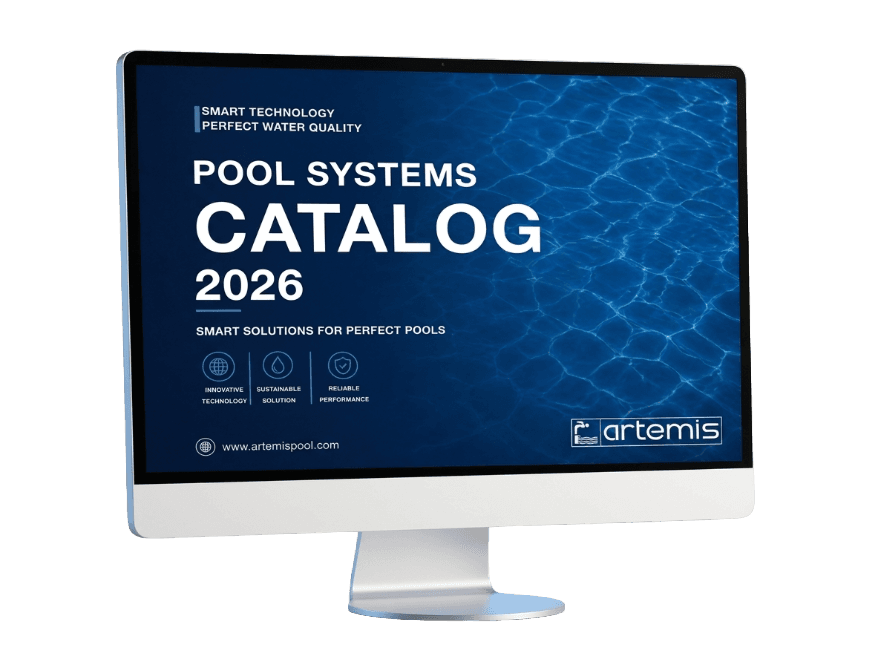
Explore our full product range, project applications, and service areas in detail through our E-Catalogue. Our engineering-led solutions and internationally certified services are presented in this comprehensive reference document.
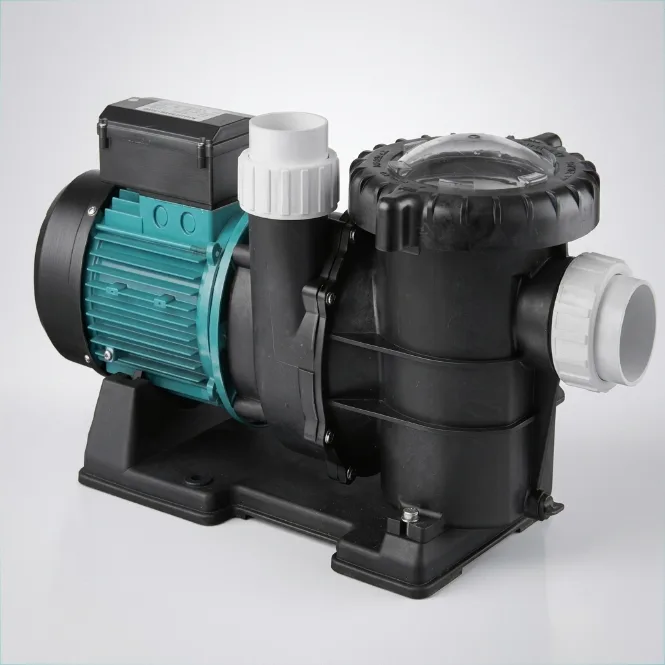
Enter your pool dimensions to calculate turnover rate, required filtration area, pump capacity, and heating demand in a single report.
This tool applies standardized engineering methods compliant with TS 13661, DIN 19605 / TS 13661, and FINA guidelines. It calculates preliminary design parameters (system flow rate, filtration vessels, pump capacities, balance tank volume, heating load, and inlet nozzle count) for your pool dimensions.
Calculates the turnover flow rate based on bather load, surface area per user, and disinfection method according to TS 13661 standards. This forms the foundation of pump and filter sizing.
Divides total flow rate by standard filtration velocity to determine total filter surface area and vessel count, alongside pump flow and redundant backup pump configurations.
Computes heat exchanger thermal capacity (kcal/h & kW) from target water temperature differentials and calculates the required return inlet nozzle count to ensure uniform hydraulic circulation.
Enter your pool dimensions and system preferences to instantly generate an engineering report covering circulation flow, filter, pump, nozzle, heating, and overflow grating sizing.
Pool Type & Dimensions
Pool Results
Indoor pools: 10–15%, overflow default 12.5%. Skimmer systems: 0 m³.
Qs Inputs & Total Flow
Qs = (n / a) × (A / k)
Duty = round(Np), Np = (Qs + Additional) / Qp. Total = duty + standby.
Bn = Qs / BnQ; rounded up to the next even number.
q is set automatically: 104 kcal/m²·h outdoors, 645 kcal/m²·h indoors.
Based on your inputs, the recommended equipment capacities are summarized below.
Qs = (n / a) × (A / k)
When perimeter is known: 20 cm width up to 100 m³, 25 cm width above.
This report offers a preliminary design estimate using general formulas based on TS 13661 and related standards; final equipment selection requires detailed engineering with on-site data.
 Generated: October 7, 2026
| Pool System | Overflow (Deck-Level) |
|---|---|
| Pool Area | — m² |
| Pool Volume | — m³ |
| Balance Tank | — m³ |
| Total Water Volume | — m³ |
| Qs (Circulation Flow) | — m³/h |
| Selected Filter | — |
| Selected Pump | — |
| Inlet Nozzles | — |
| Heat Exchanger Capacity | — |
| Heat Pump Capacity | — |
| Overflow Grating | — |
Starting from pool surface area and depth/volume, it calculates system circulation turnover rate (Qs), required filtration area and vessel counts, pump sizing with standby units, balance tank volume, heating exchanger power, and return nozzle distributions.
No. This calculator provides accurate preliminary feasibility values based on TS 13661 formulas. For final construction shop drawings, site-specific geotechnical, climate, and hydraulic piping friction losses must be engineered by Artemis Pool specialists.
For non-rectangular or freeform pool shapes, select 'Manual Surface Area' and directly input the total water surface area (m²); all subsequent hydraulic equations will function seamlessly.