

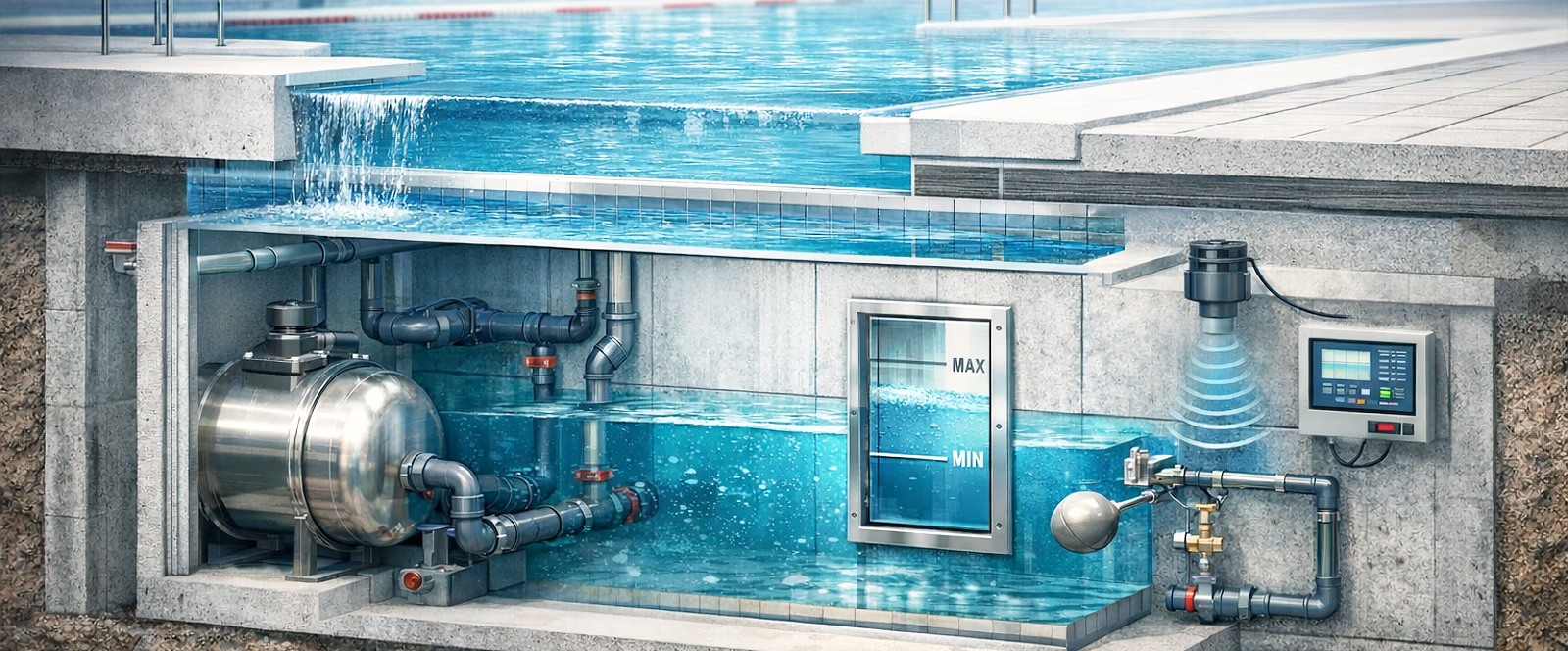
What Is a Pool Surge/Balance Tank and How Is It Sized?
A pool balance (surge) tank is an intermediate water reservoir required in overflow and infinity pools to absorb bather displacement volume (75L/person), catch wave surge (10L/m² surface area), and hold reserve water for filter backwashing. Its capacity typically equals 8% to 12% of total pool volume.
A balance tank is one of the most critical engineering components used in overflow swimming pools to keep the water level stable, recover overflowing water, and ensure the system runs without interruption. Especially for Olympic swimming pools and heavily used swimming pools, a correctly designed balance tank system plays a decisive role in both hygiene and performance.
This guide has been prepared to be the most comprehensive technical resource on balance tanks.
MENU
What Is a Balance Tank? The Critical System That Keeps Pool Water Level Stable
A Pool System Cannot Operate Without a Balance Tank
A balance tank is the fundamental engineering component that keeps the water level stable in overflow swimming pools, recovers overflowing water, and ensures the filtration system runs without interruption. Especially in heavily used Olympic and commercial pools, it directly affects both hygiene and system performance by balancing water fluctuations. A correctly designed balance tank prevents water loss, protects pump systems, and ensures the pool operates stably under any condition.
Definition of a Balance Tank
A balance tank is a reservoir system where water coming from the overflow channels is collected, stored, and returned to the filtration system in a controlled manner.
What Should Be Considered When Choosing a Balance Tank?
When selecting a balance tank, pool volume, user density, filtration flow rate, and project type must be considered. An incorrect capacity choice can cause system imbalance and serious performance losses.
Why Is a Balance Tank Required?
In overflow pools, when a user enters the pool, the water level rises and flows out through the overflow channels. When the user exits, the water level drops. If this change is not controlled:
- Pumps draw in air
- The filtration system malfunctions
- Water level fluctuates
- Hygiene deteriorates
The balance tank absorbs these changes, keeping the system stable.
How Does a Balance Tank Work?
- Water overflowing from the pool enters the overflow channels
- Water collects in the balance tank
- Pumps draw the water in
- It is sent to the filter
- Cleaned water is returned to the pool
How Is Balance Tank Volume Calculated?
1. Basic Formula
The following components are considered when calculating balance tank volume:
- Bather displacement volume
- Wave effect
- Filtration reserve
2. Engineering Approach
General formula:
A = Pool surface area (m²)
k = overflow coefficient (0.01–0.03)
N = number of simultaneous users
3. Real Project Example
Pool: 25m x 12.5m = 312.5 m²
Users: 50 people
Balance tank ≈ 20 – 35 m³
For a detailed calculation, check out our calculation report page.
Balance Tank Types (Comparative)
1. Polyethylene Balance Tanks
- Inexpensive
- Easy installation
- Suitable for small volumes
2. GRP (Fiberglass) Balance Tanks
- High chemical resistance
- Long lifespan
- Ideal for mid-to-upper-tier projects
3. Stainless Steel Balance Tanks
- Hygienic
- Premium solution
- Hotel and spa projects
4. Reinforced Concrete Balance Tanks
- Very large volumes
- Long lifespan
- High initial cost
Which Balance Tank Should Be Used in Which Project?
While polyethylene tanks offer an economical solution for small-volume pools, GRP tanks are preferred for mid-scale projects. For large and professional facilities, reinforced concrete or stainless steel tanks provide long life and high durability.
Level Monitoring Systems
Level Glasses (Manual)
Level glasses are simple, reliable systems that let an operator directly and visually monitor the water level in the balance tank. The tank's minimum and maximum levels can be easily checked through these glasses. Because they require no electricity and are easy to maintain, they are widely used especially in systems where manual control is preferred.
Ultrasonic Level Sensor
Ultrasonic level sensors are modern devices that measure the water level in the balance tank without contact, offering high precision. The level is calculated from the return time of an ultrasonic signal reflecting off the water surface, and this data is relayed to the automation system. This allows the water level to be continuously monitored and the system to be fully automatically controlled.
Level Switches
Level switches are practical devices that provide on/off control at set minimum and maximum water levels in the balance tank. When the water level reaches critical points they engage pump or valve systems, ensuring safe operation. They offer an economical and effective solution, especially in simple automation applications.
Level monitoring systems are critical for the balance tank to function correctly. Using manual and automatic solutions together maximizes both safety and system continuity.
Make-up Water Systems
Float Valve System
The float valve system is a practical, economical solution that supplies make-up water to the balance tank in a fully mechanical way. When the water level drops, the float opens the valve mechanism and water is automatically fed into the tank; once the level reaches the desired point, the system shuts itself off. Because it requires no electricity and has a low failure risk, it is widely used especially in standard swimming pools.
Solenoid Valve System
The solenoid valve system is a professional solution that controls make-up water supply to the balance tank via automation. The water level is continuously monitored by sensors, and when it drops to the set minimum, the valve opens automatically to feed water into the tank. Once the maximum level is reached, the system shuts itself off. Because of its precise control capability, water savings, and elimination of human error, it is the standard choice especially in Olympic and commercial pool projects.
Critical Rules in Balance Tank Design
- Pumps must draw from the bottom
- A bottom drain must always be present
- The overflow line must be at the top
- Maintenance access must be easy
- Ventilation must not be forgotten
THE MOST COMMON MISTAKES
- Choosing insufficient volume
- Incorrect pump suction point
- No level control system
- Not planning for cleaning access
Professional Balance Tank Placement
The balance tank should generally be positioned close to the plant room. This reduces piping losses and increases system efficiency.
Maintenance and Cleaning
- Cleaning 2-3 times a year
- Biofilm control
- Using the bottom drain
- Sensor calibration
CONCLUSION
A balance tank is one of the most critical engineering components that ensures overflow swimming pools operate healthily, safely, and efficiently. By balancing the water level fluctuations that occur in the pool, it contributes to the filtration system running without interruption, and by recovering overflowing water it provides significant water savings. Especially in Olympic, commercial, and heavily used pools, a correctly engineered balance tank system is indispensable for both maintaining hygiene standards and sustaining system performance.
Choosing the correct volume for the balance tank, designing it with suitable materials, and supporting it with level control systems increases pump efficiency, optimizes energy consumption, and lowers operating costs. At the same time, balance tanks integrated with automation systems keep the water level under continuous control, minimizing the need for human intervention and raising system safety to the highest level.
In conclusion, in a professional pool project the balance tank is not just an auxiliary piece of equipment but a fundamental element forming the heart of the system. A balance tank designed with the correct engineering approach plays a critical role in achieving a long-lasting, sustainable, and high-performance pool system.
Frequently Asked Questions
Is a balance tank mandatory?+
Yes, it is mandatory for overflow (deck-level) pools.
How many cubic meters should a balance tank be?+
Generally 5-10% of the pool volume.
Which balance tank type is best?+
It depends on the project. Reinforced concrete is recommended for large projects.
How is balance tank volume calculated?+
Balance tank volume is calculated by taking into account the pool surface area, user density, overflow amount, and filtration flow rate. While 5-10% of the pool volume is generally used as a reference, professional projects may opt for higher volumes based on user load.
Where should the balance tank be positioned?+
The balance tank is generally positioned close to the plant room and below ground level. This ensures natural water flow, increases pump efficiency, and minimizes system losses.
How is the water level controlled in a balance tank?+
The water level is controlled with level glasses and floats in manual systems, and with ultrasonic sensors, level switches, and solenoid valves in automatic systems. Automated systems provide more precise and reliable control.
Can a pool run without a balance tank?+
In overflow pool systems, stable and healthy operation is not possible without a balance tank. The water level cannot be controlled, the filtration system runs irregularly, and hygiene drops significantly.