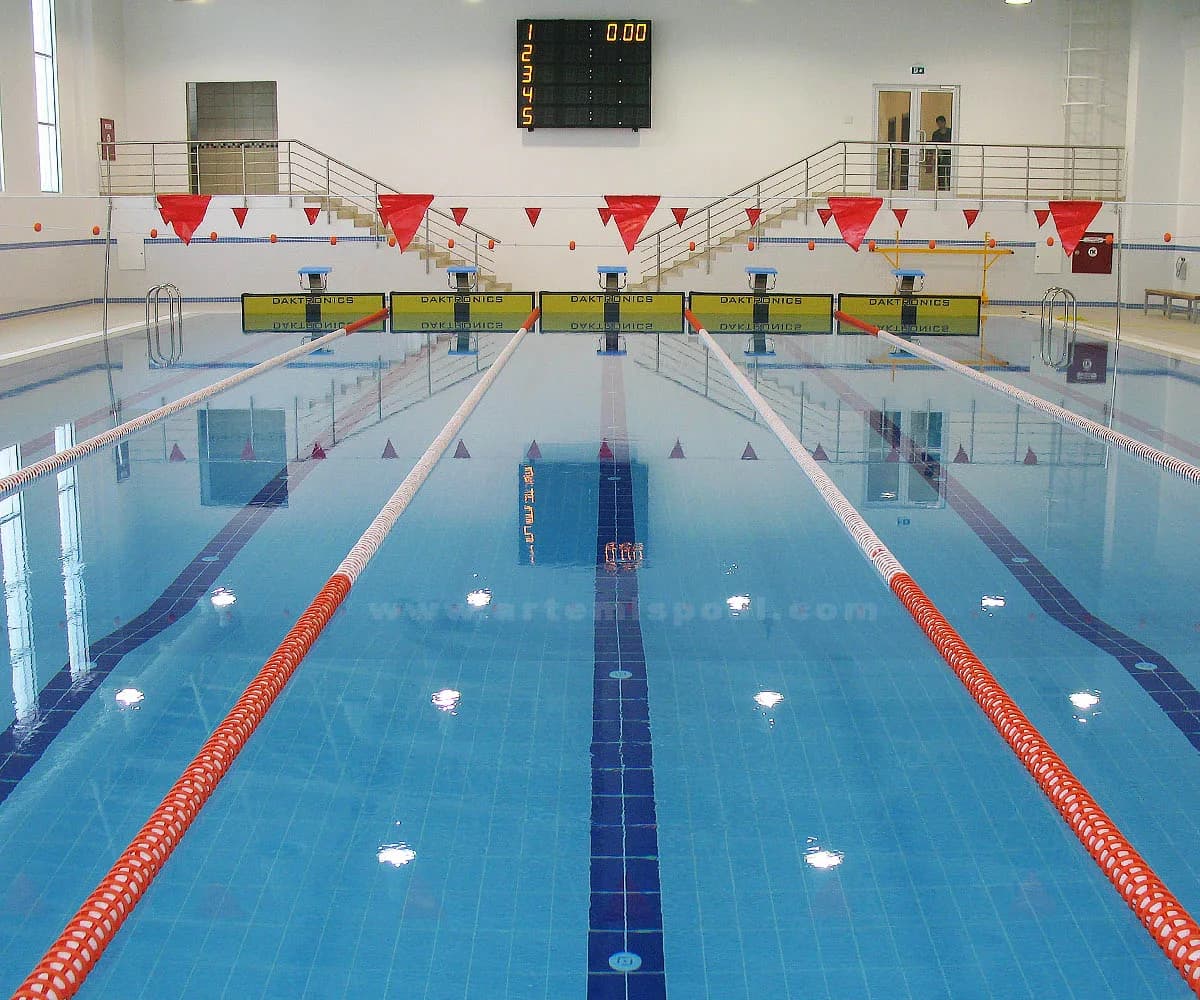
What should you look for when choosing a swimming pool scoreboard?
Five criteria decide scoreboard selection: character height based on the farthest viewer (about 5 mm per metre of viewing distance for comfortable reading), the pool's lane count (10 lines, lanes 0–9, in an Olympic pool), 1,500–2,500 nit brightness indoors and 5,000–7,000 nit outdoors, IP65 front protection and direct data integration with the touchpad timing system.
In a competition pool, the scoreboard is the face of the timing system turned towards spectators, coaches and athletes. Even if the touchpad measures milliseconds correctly, the whole system looks weak if the scoreboard cannot be read from the stands, does not cover the number of lanes or fails within a few seasons because of chlorinated humidity. We explained how a scoreboard works in our article How Scoreboard Systems Work in Competitive Swimming; this guide focuses on the next step: choosing the right scoreboard.
Below we cover, in order, scoreboard types, display size and character height calculation, pixel pitch selection for graphic LED displays, brightness and ingress protection, suitability criteria for international competition, mounting location and timing integration. At the end of the article you will find an 11-point checklist you can use when comparing quotes.
What types of pool scoreboards are there?
There is no single “scoreboard” in swimming pools; depending on how the facility is used, there are several complementary display types. The right choice starts with deciding which information will be shown to whom.
- Lane scoreboard: Shows the lane number, place and time for each lane with segment digits. It is the most common and most economical solution in club and school pools.
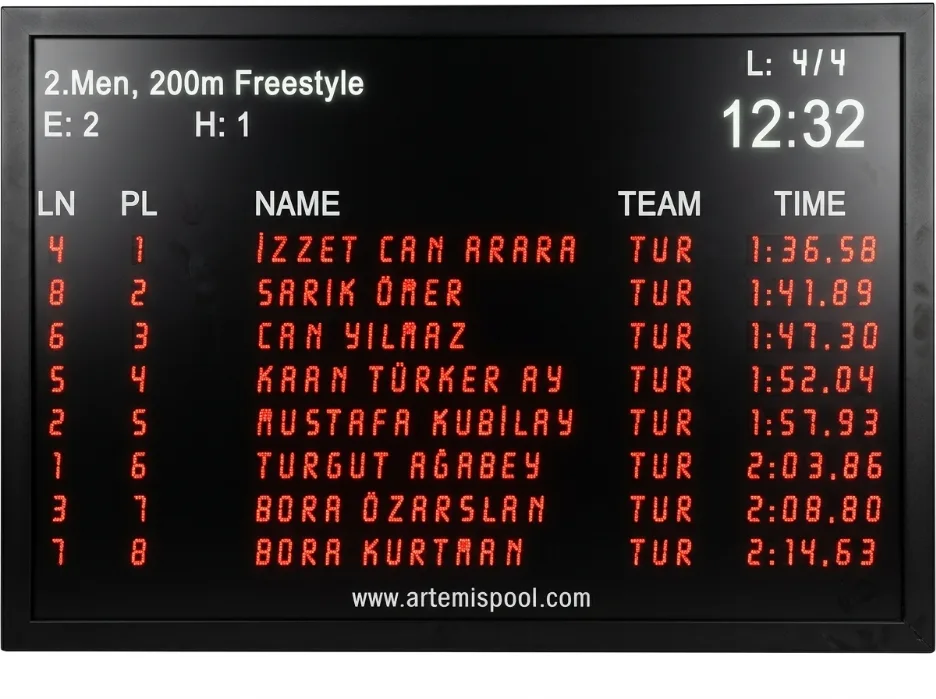
- Graphic (matrix) LED scoreboard: Shows all race data — event name, heat number, athlete name, team, split and final times — in letters and digits. It is preferred in facilities hosting national and international competitions.
- Record scoreboard: Permanently displays facility, national and world records; it is updated when a record is broken during the race.
- Team scoreboard: Tracks team points and rankings in relay and team events.
- Water polo scoreboard and shot clocks: Shows match time, period, score and the 30-second shot clock. Swimming scoreboards can be switched to water polo mode with a software change.
You can review the technical dimensions and power ratings of all display types in the equipment tabs on our Scoreboard Systems service page, and complementary products such as starting blocks and lane ropes in our Olympic Pool Equipment category.
How are scoreboard display size and character height calculated?
The value that really determines scoreboard size is not the display itself but the height of the characters on it. Character height is chosen according to the distance of the farthest person watching the display, i.e. the back row of the stands or the start area at the opposite end of the pool. Display width and height are then the result of this character height and the number of lines and columns to be shown.
The practical approach used in the industry defines two thresholds: about 5 mm of character height per metre of viewing distance for comfortable reading, and about 2 mm for the lower limit of legibility. This is not a standard but a common engineering convention among LED display manufacturers; if scoreboard brightness and contrast are high, you can approach the lower limit, but in facilities where race results must be readable by everyone, the comfortable reading threshold should be the basis.
Character height calculation
Comfortable reading: H (mm) ≈ D (m) × 5
Lower limit: H (mm) ≈ D (m) × 2
H = character height · D = distance from the scoreboard to the farthest viewer
Example: In an 8-lane, 50 m indoor pool, if the back seat of the stands is 34 m from the scoreboard, comfortable reading requires 34 × 5 ≈ 170 mm characters. In that case a lane scoreboard with 180 mm segment digits available on the market is the right choice; a display with 100 mm digits only meets the lower limit.
| Farthest viewer | Comfortable reading | Lower limit | Typical facility |
|---|---|---|---|
| 15 m | 75–100 mm | 30 mm | School, hotel and training pool |
| 25 m | 125–150 mm | 50 mm | 25 m short-course semi-Olympic pool |
| 35 m | 175–180 mm | 70 mm | 50 m Olympic pool with stands |
| 50 m | 250 mm | 100 mm | International facility with large stands |
What pixel pitch should a graphic LED scoreboard have?
On graphic scoreboards the image is created by a matrix of LED pixels. The distance between the centres of two pixels is called the pixel pitch and is written in millimetres, such as “P10”. As pixel pitch gets smaller the image looks sharper up close, but for the same display area the number of LEDs and the cost increase quadratically.
The common rule is this: the minimum viewing distance in metres is approximately equal to the pixel pitch in millimetres; the ideal viewing distance is 2–3 times that. Because the nearest viewer in a swimming pool is usually the front row of the stands or the officials' table at the poolside, P6–P10 for indoor pools and P10–P16 for outdoor pools gives the right balance in most projects.
| Pixel pitch | Minimum viewing | Ideal viewing | Suitable use |
|---|---|---|---|
| P6 | 6 m | 12–18 m | Indoor pool with small stands, close viewing |
| P8 | 8 m | 16–24 m | Indoor semi-Olympic and Olympic pool |
| P10 | 10 m | 20–30 m | Large indoor hall or shaded outdoor pool |
| P16 | 16 m | 32–48 m | Outdoor Olympic pool in direct sunlight |
On displays that show only digits, such as lane scoreboards, segment height is discussed instead of pixel pitch; for these displays the character height calculation in the previous section is used directly.
What brightness and ingress protection should a scoreboard have in indoor and outdoor pools?
Brightness is expressed in nits (cd/m²). 1,500–2,500 nit is sufficient in indoor pools; higher brightness both tires the eyes and causes reflections on the water surface. Outdoor pools in direct sunlight require 5,000–7,000 nit. A good scoreboard has an ambient light sensor and adjusts brightness automatically during the day; this prevents glare in evening races and reduces energy consumption.
A pool hall is a harsh environment for electronics: high relative humidity, chlorine and chloramine vapour and splashing water are all present at once. For this reason the scoreboard's front should have at least IP65 and its rear at least IP54 protection according to EN 60529, and the circuit boards should be protected against moisture and chemical vapour with a conformal coating. Look for aluminium or corrosion-resistant painted steel for the housing and stainless steel for fasteners.
- Indoor pool: 1,500–2,500 nit, IP65 front, IP54 rear, conformally coated boards.
- Outdoor pool: 5,000–7,000 nit, IP65 front and rear, UV-resistant housing and front panel.
- In both cases: wide horizontal viewing angle (at least 140°), anti-glare front and automatic brightness control.
In indoor pools, humidity control directly affects scoreboard life; you can find how humidity and ventilation are planned in the hall in our article Indoor Swimming Pools.
How many lanes and which race information should a scoreboard show?
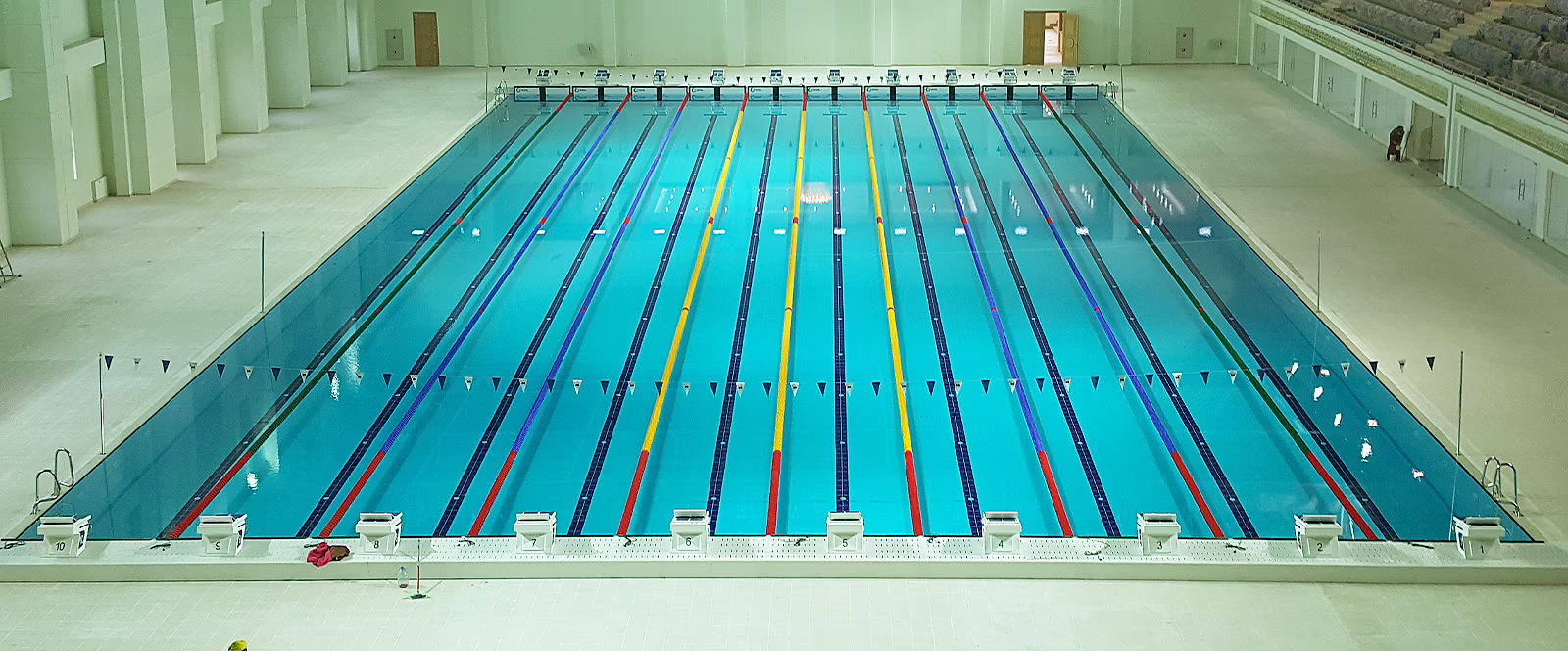
The number of scoreboard lines should equal the pool's number of lanes. Under World Aquatics facility rules (FR), Olympic and world championship pools are planned with 10 lanes numbered from 0 to 9; therefore, in a 50 m pool aiming for international competition, the scoreboard should show 10 lines. 8 lines are sufficient in 8-lane semi-Olympic and club pools, but if lanes may be added in the future, choosing a modular display is economical.
Under World Aquatics swimming rules (SW 11), official times are recorded and displayed to one hundredth of a second. Even if the timing system works internally at a higher resolution, the scoreboard should give the time with two decimal places, in the form “1:52.04”. We explained in detail how pool dimensions and lane layout affect each other in our Olympic Pool Dimensions Guide.
Fields a graphic scoreboard should display
The basic fields that spectators and officials expect at national and international competitions are:
- Event number and name (for example “200 m Freestyle Men”) with the heat number
- Running race time and completed lap information
- Lane number, place, athlete name and team/country code
- Split times and final time
- Facility, national or world record indicator when a record is broken
- Early takeover (relay takeover) and disqualification indicator in relays
Is every scoreboard suitable for international competitions?
No. Not every scoreboard is suitable for international competitions. A scoreboard showing technically correct times does not mean that international competitions can be held at that facility. At international competitions the scoreboard is not evaluated on its own but as a whole together with the start system, touchpads, lane boxes, control unit and results software, and this whole must meet certain criteria.
The first and most decisive criterion is the brand. The brands of the scoreboard system and its complementary products (timing system, touchpads, starting blocks, lane ropes) must be official partners or sponsors of World Aquatics, or be selected from among the brands approved by this organisation. At the highest-level events such as the Olympic Games and world championships, only equipment from these brands is used; at continental championships and international meets, the organising federation also requires the same.
For this reason, you need to clarify what level of competition you want to host at your facility before choosing a scoreboard. For club races, school competitions and training, a high-accuracy, CE-certified system with test reports is sufficient; for national championships the requirements of the Turkish Swimming Federation apply, and for international competitions those of World Aquatics and the relevant continental federation (European Aquatics for Europe).
Main criteria for scoreboard and timing systems at international competitions
Before accepting a facility for a competition, the organising federation usually checks the following points:
- Brand approval: The scoreboard and complementary product brands are World Aquatics partners, sponsors or approved suppliers
- Integrated automatic officiating system: The start system, false start detection, touchpads at both ends of the pool and backup push buttons work as a single system
- Lane capacity: All 10 lanes, numbered 0–9, in an Olympic pool are shown on the scoreboard
- Time display: Official times are given to 0.01 seconds, together with split times, places and a record indicator
- Redundancy: A backup timing and race recovery feature that keeps the race running without interruption if the main system fails
- Data output: Results can be transferred to the official results software, television broadcast graphics and online live results systems
- Certification: CE certification of the products, an independent laboratory accuracy test report and a facility approved (homologated) by the federation
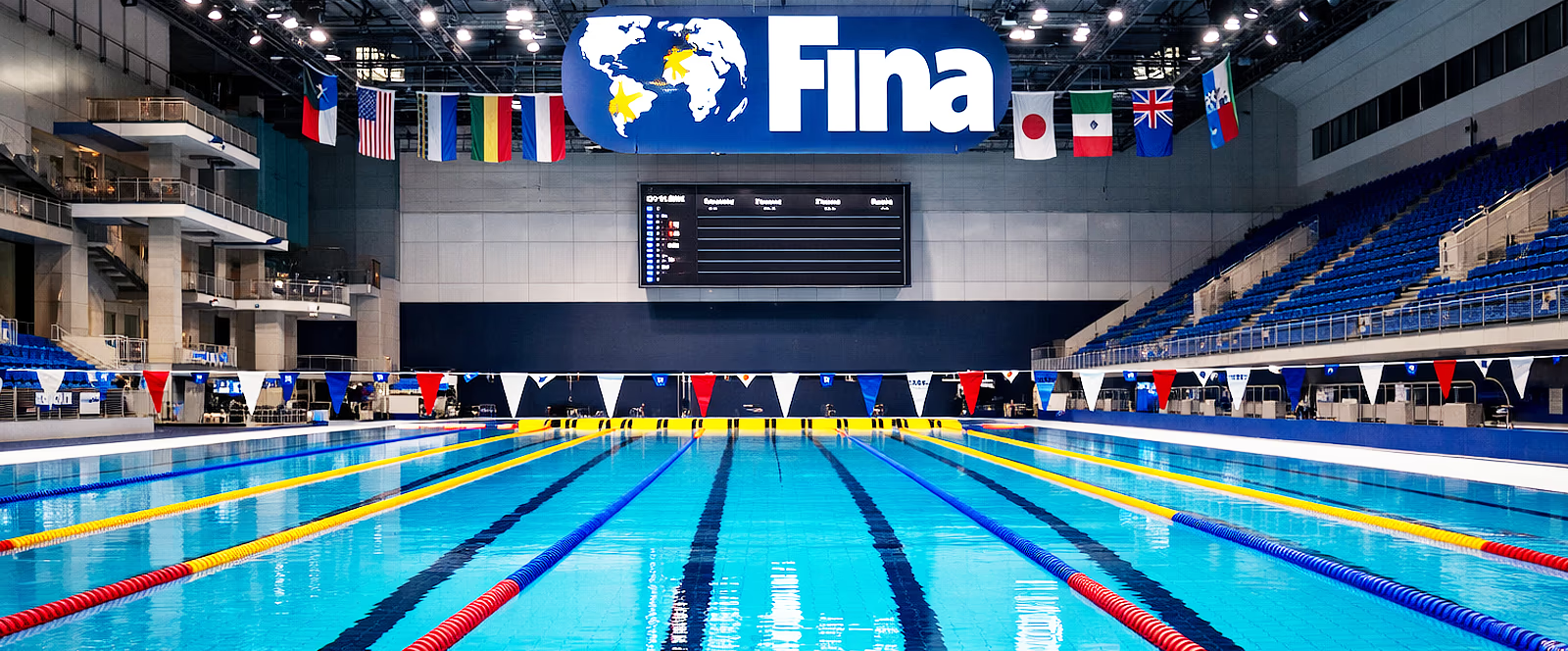
When requesting a quote, ask the supplier in writing for a document showing the proposed brand's relationship with World Aquatics and a declaration of suitability for the competition level you are targeting. You can find the pool geometry requirements for international competitions in our article FINA Pool Standards.
Where and how should a scoreboard be mounted?
The scoreboard is placed where it can be seen at the same time by spectators in the stands and athletes at the poolside. In most projects this is the long wall opposite the stands or the wall above the finish end. A scoreboard at the finish end lets the athlete who finishes the race see their time without turning away from the wall; a scoreboard opposite the stands gives spectators the best angle. Large facilities therefore use two displays together.
The most overlooked issue in mounting is daylight. A scoreboard placed opposite windows or a glass façade both receives direct light during the day and becomes unreadable because of reflections on the water surface. The bottom edge of the display should usually be at least 2.5–3 m above the floor so that people and equipment at the poolside do not block the view, and the display should be mounted tilted slightly towards the stands.
Infrastructure to plan at the design stage
Although a scoreboard looks like a device bought later, if the cable and power infrastructure is not prepared during construction, you are forced to break walls, run surface-mounted trunking or move the installation to an undesirable location. That is why the scoreboard decision must be made at the project design stage.
- Empty conduit and draw wire for the data line (RS-485 or Ethernet) from the timing console to the scoreboard
- A separately fused, RCD-protected 230 V supply line for the scoreboard (example: a lane scoreboard draws 475 W on average and 900 W at most)
- Wall anchors or a steel bracket to carry the scoreboard's weight (a lane scoreboard weighs about 75 kg)
- Touchpad and lane box connection sockets at both ends of the pool
- An access area or platform behind or in front of the display for maintenance
How does a scoreboard integrate with the timing system?
A scoreboard does not measure time on its own; it receives the time from the timing system. When the start device starts the race, the system control unit starts the clock; when the athlete touches the touchpad on the finish wall, the time for that lane stops and the data goes via the lane box to the control unit and from there to the scoreboard. You can find how a touchpad works in our article What Is a Touchpad System?, and the system as a whole in Olympic Pool Timing Systems.
When choosing, make sure the scoreboard speaks the same data protocol as the existing or planned timing system. Combining equipment from different brands often requires intermediate converters and custom software, which increases the number of failure points. In the systems installed by Artemis, the start, touchpads, lane boxes, control unit, thermal printer and scoreboard work as a single system; the timing system has been verified in TÜBİTAK UME tests with a deviation of 0.000 seconds over 10 minutes.
If the scoreboard is to be managed centrally together with the sound and lighting systems, it can be connected to the pool automation infrastructure.
11-point checklist for comparing scoreboard quotes
The difference between two quotes that look the same is usually revealed by these questions:
- 01Has the farthest viewer distance been measured, and was the character height chosen accordingly?
- 02Does the scoreboard's number of lines equal the pool's number of lanes (10 in an Olympic pool)?
- 03Is there 1,500–2,500 nit brightness for an indoor pool, 5,000–7,000 nit for an outdoor pool, and automatic brightness control?
- 04Is the front IP65 and the rear at least IP54, and are the circuit boards conformally coated?
- 05On a graphic scoreboard, is the pixel pitch suitable for the nearest viewer distance?
- 06Does the scoreboard use the same data protocol as the timing system without an intermediate converter?
- 07Can times be shown to 0.01 s, together with split times and a record indicator?
- 08Are additional use scenarios such as water polo, diving or training mode supported by the software?
- 09Are the data line, power line and wall anchors included in the project drawings?
- 10If international competition is the goal, are the scoreboard and complementary product brands World Aquatics partners, sponsors or approved brands?
- 11Were the CE certificate, warranty period, spare parts and service time provided in writing?
Conclusion: Choose the scoreboard as a system, not as a display
The right scoreboard is not the largest or brightest display in the catalogue. It is the display that has a character height readable from the back row of the stands, matches the pool's number of lanes, has the protection and brightness the environment requires for humidity and light, and works with the timing system as a single system. When these decisions are made before construction starts, the cable, power and mounting infrastructure is also prepared at no extra cost.
If you would like to plan the scoreboard, touchpad and timing infrastructure together for your competition pool project, you can review our Olympic Pools and Scoreboard Systems pages, and contact us for a size and layout proposal tailored to your facility.
Frequently asked questions about pool scoreboards
How large should a swimming pool scoreboard be?
Scoreboard size is calculated from the character height and the number of lines to be shown. For comfortable reading, about 5 mm of character height is needed per metre of distance to the farthest viewer; for example 170–180 mm for a 34 m distance. The number of lines should equal the number of lanes.
How many lanes should an Olympic pool scoreboard show?
Under World Aquatics facility rules, Olympic and world championship pools are planned with 10 lanes numbered from 0 to 9. Therefore, in 50 m pools aiming for international competition, the scoreboard should show 10 lines; in 8-lane pools, 8 lines are sufficient.
How many nits of brightness are enough for an indoor pool scoreboard?
1,500–2,500 nit brightness is sufficient in indoor pools. Higher brightness causes reflections on the water surface and eye fatigue. Outdoor pools in direct sunlight require 5,000–7,000 nit; automatic brightness control is recommended in both cases.
Should you choose a graphic scoreboard or a lane scoreboard?
In club and school pools where only lane, place and time will be shown, a lane scoreboard is sufficient and economical. In national or international competition facilities where athlete name, team, split time and race information will be shown, a graphic LED scoreboard should be preferred.
Can a scoreboard be added to an existing pool later?
Yes, but if the data and power lines were not prepared during construction, surface-mounted trunking, wall breaking or an undesirable mounting location may be needed. Portable lane scoreboards and wirelessly connected solutions can be added to existing pools without renovation.
Can every scoreboard be used at international competitions?
No. At international competitions, the brands of the scoreboard and complementary products (timing, touchpads, starting blocks) must be World Aquatics partners, sponsors or among the brands it approves. The system is also expected to show 10 lanes and meet the 0.01 s resolution, backup timing and federation approval requirements.
Can a swimming scoreboard be used for water polo matches?
Yes. Swimming scoreboards with suitable software can be converted into water polo scoreboards with a program change, showing match time, period and score. 30-second shot clock devices are positioned separately at both ends of the pool.
Let's determine the right scoreboard for your facility together
Share the pool size, number of lanes and stand layout; we will prepare a free preliminary assessment for character height, display type and mounting location.