
What are the exact official Olympic pool dimensions according to World Aquatics?
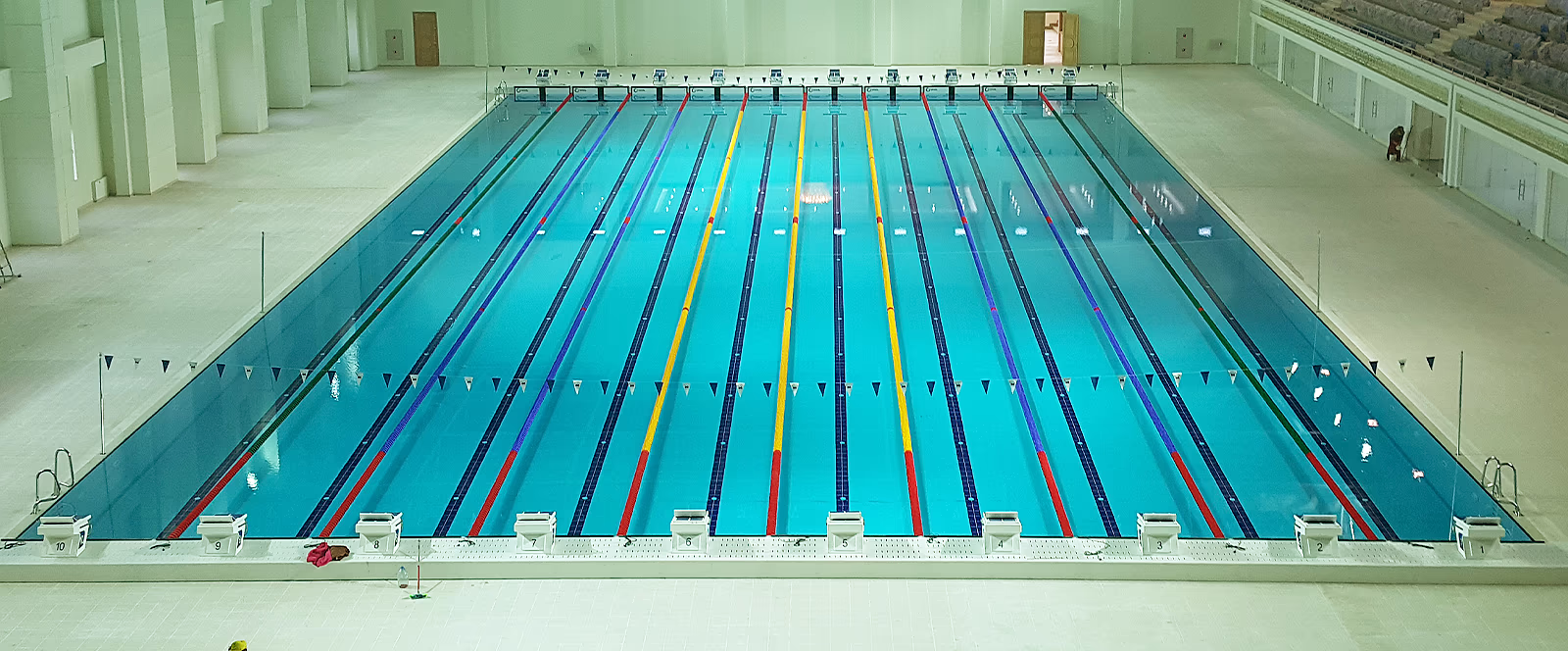
A full Olympic competition pool measures exactly 50.00 meters in length (within 0.000 to +0.010 m tolerance including touchpads), 25.00 meters in width with 10 lanes (8 racing lanes at 2.50m each plus two 2.50m side buffer lanes), and a minimum depth of 2.00m (3.00m recommended for Olympic & World Championships).
Olympic swimming pools are built according to the precise technical rules set by World Aquatics (formerly FINA), the world swimming federation, so that international swimming competitions (World Championships, Olympic Games, European Championships, etc.) can be held fairly, to a standard, and with millisecond-level accuracy.
A pool being 50 meters only in appearance is not enough for it to earn the Olympic title. Every detail, from water depth to lane markings, from the reinforced concrete manufacturing tolerance to the millimetric distances occupied by the touchpads, must comply with engineering standards.
In this guide, we cover in detail the technical dimensions, lane and depth criteria, FINA water hygiene standards, and timing system placement of Full Olympic (50m) and Semi-Olympic (25m) swimming pools.
1. Full Olympic Pool Dimensions (50 Meter Standards)
Full Olympic swimming pools are designed at 50.00 meters in length and 25.00 meters in width. Pools used in world championships and official competitions have 10 lanes.
Full Olympic Pool (50m) Dimension Table
2. Semi-Olympic Pool Dimensions (25 Meter Short Course)
Semi-Olympic swimming pools (Short Course) are generally used in club training, schools, and regional race organizations.
Semi-Olympic Pool (25m) Dimension Table
3. Lane & Depth Standards
Special wave-breaking lane ropes and ideal depth ratios are used so that the water waves created by swimmers do not slow down athletes in other lanes.
- Wave Damping: The outermost lanes numbered 1 and 10 in the pool are used to absorb wall-reflection waves.
- Depth Effect: When water depth drops below 2.00 meters, turbulence reflected from the bottom surface negatively affects athletes' speed. For this reason, a fixed depth of 3.00m is preferred in modern race pools.
4. FINA Water Temperature & Hygiene Criteria
According to World Aquatics standards, water parameters must be kept within the following ranges during competition:
Water Temperature
25.0°C – 28.0°C (Must be kept constant)
pH Value
7.2 – 7.6 ideal range
5. Lighting & Acoustic Standards
A minimum lighting intensity of 1500 Lux must be provided at the start and finish points so that no shadows or glare occur during competitions and live television broadcasts.
6. Timing & Touchpad Positioning
When touchpads are mounted on the pool wall, they record time at the millisecond level upon contact with the swimmer's hand. For detailed timing systems, you can review our Olympic Pool Timing Systems article.
7. Balance Tank & Filtration Calculation
A full Olympic pool has a water volume of approximately 2,500 m³ (2.5 million liters). This water must be completely filtered every 4 hours. For the related balance tank capacity calculation, you can review our What Is a Balance Tank? guide.
Conclusion
Olympic pool construction is not merely about pouring concrete; it is a high-level engineering discipline that requires millimetric manufacturing precision, correct filtration infrastructure, and FINA-compliant lane design.
Frequently Asked Questions
What are the length and width of a full Olympic pool in meters?+
According to World Aquatics (FINA) standards, a full Olympic swimming pool must be 50.00 meters in length and 25.00 meters in width. A tolerance margin must be left during construction to ensure the net lane distance remains exactly 50.00 meters once the touchpads are installed.
What should the minimum water depth be in Olympic pools?+
The recommended standard depth for official Olympic races and world championships is at least 2.00 meters, and 3.00 meters under ideal race standards. In semi-Olympic club and training pools, a minimum depth of 1.35 meters is acceptable.
How many lanes does an Olympic pool have and what is the lane width?+
Full Olympic race pools have 10 lanes. Races are held in the middle 8 lanes, while the outermost lanes numbered 1 and 10 are left empty for wave damping (buffer zone) purposes. Each lane is exactly 2.50 meters wide.
What should the water temperature be in an Olympic pool?+
According to FINA rules, the water temperature during competition must remain fixed between 25°C and 28°C. Because sudden fluctuations in water temperature negatively affect athlete performance, precise climate control and heat pump automation are used.
Do touchpad panels affect the pool length?+
Yes, touchpad panels have a calibration thickness of approximately 1 cm when mounted on each finish wall. For this reason, the reinforced concrete length must be designed as 50.02 - 50.03 meters during pool construction.