

Explore our full product range, project applications, and service areas in detail through our E-Catalogue. Our engineering-led solutions and internationally certified services are presented in this comprehensive reference document.
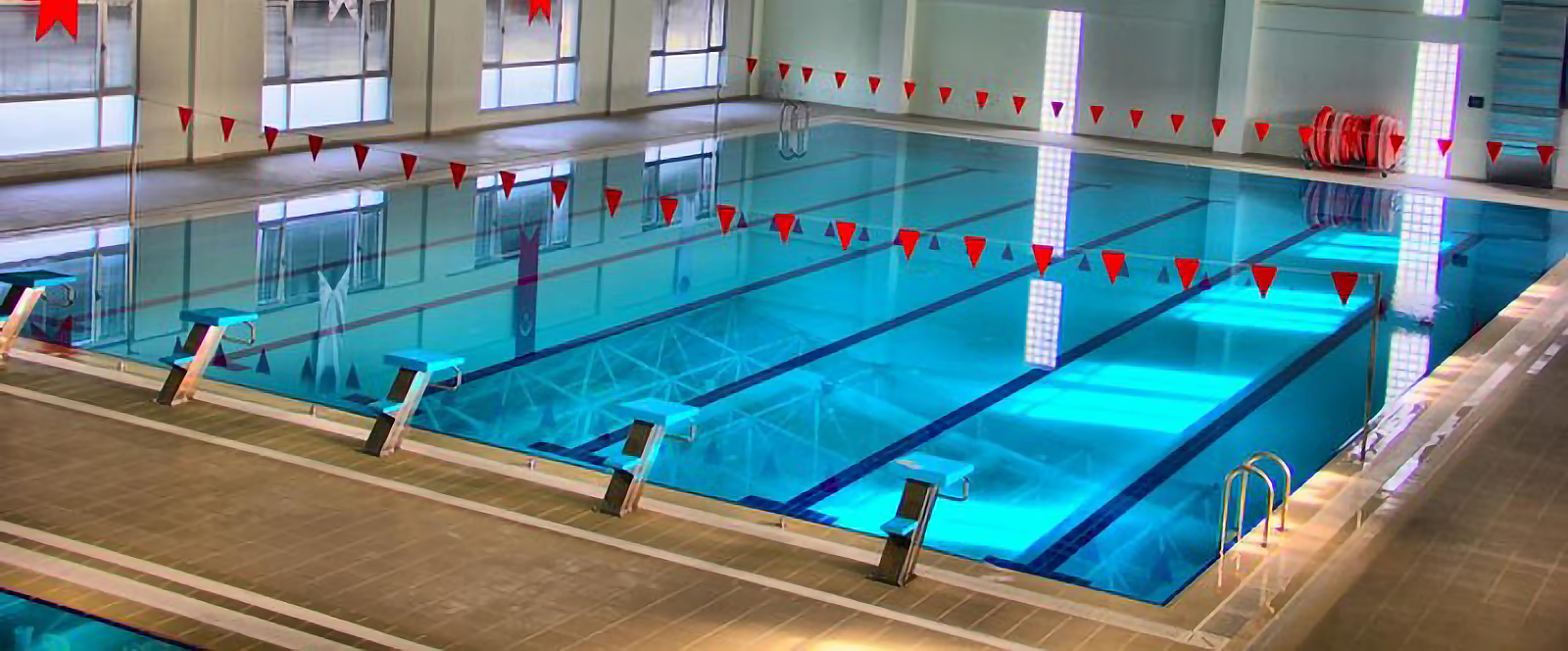
The Olympic pool timing system used in professional swimming competitions is an automatic timing infrastructure that operates with touchpad panels, lane box units, and central control software. These systems measure race results with millisecond precision, ensuring the implementation of international race standards.
Accurately and reliably measuring athletes' times is of great importance in modern swimming competitions. The Olympic pool timing system used in professional race organizations consists of advanced electronic technologies capable of measuring athletes' performances with millisecond precision. These systems not only measure time; they simultaneously perform many functions such as race management, data recording, publishing results, and displaying them on scoreboard screens.
Today, the swimming pool timing system used in international swimming competitions works together with touchpad panels, lane box units, the start system, and central control software. Thanks to these systems, race results are automatically measured without the need for human intervention and recorded with high accuracy.
These technologies used in competition pools work integrated especially with scoreboard systems , ensuring that race results are instantly shown to spectators and athletes.
An Olympic timing system integrates an acoustic/strobe electronic start horn, starting blocks with false start reaction sensors (triggering under +0.04s), 0.001-second precision submerged touchpads on each lane, backup semi-automatic buttons for lane judges, and high-speed data feeds to LED scoreboards and TV broadcast graphics.
Advanced Olympic pool timing system technologies are used in professional swimming competitions to accurately measure athletes' times. These systems work together with touchpad panels, lane box units, and start devices to determine race results with millisecond precision.
This infrastructure used in modern competition pools also works integrated with scoreboard systems , ensuring that race results are instantly shown to spectators. This raises both accuracy and organizational management to the highest level in swimming competitions.
In swimming, performance differences are often determined by very small time intervals. The result of a race can be decided by milliseconds. For this reason, the timing systems used in professional race organizations must be extremely precise.
Although manual stopwatch methods were widely used in the past, international race standards today rely entirely on automatic systems. These systems measure athletes' times independently of human error, increasing the reliability of race results.
Thanks to these advantages, the Olympic pool timing system has become an indispensable part of modern race organizations.
A modern Olympic pool timing system is formed by many different electronic pieces of equipment working together. The main purpose of these systems is to accurately measure the time elapsed from the start to the finish and to record the results in the central system.
The timing systems used in professional competitions consist of the following main components:
Touchpad panels are one of the most critical timing pieces of equipment used in swimming competitions. These panels are mounted on the finishing wall of the pool and send a signal to the timing system when touched by athletes.
The touchpad system automatically records the time the moment an athlete touches the wall. This achieves much higher accuracy compared to manual timing methods.
Touchpad panels used in international race organizations are generally manufactured to dimensions compliant with FINA standards and operate with high-precision sensor technology.
Lane box devices are control units that operate separately for each lane. These units provide data communication between the start system, the touchpad panel, and the central control computer.
Lane box systems are used to record athletes' lane-based data during the race. Each lane's time is measured separately and analyzed in the central system.
The start system is the electronic starting equipment that controls the beginning of swimming competitions. The moment this system gives the start command, it automatically starts the timing system.
Modern start systems generally operate together with an audible command and a flash light. This ensures that all athletes start the race at the same instant and that timing begins in a synchronized manner.
The central control unit is the main system through which all timing equipment is managed. Data coming from touchpad panels and lane box units is gathered here, and race results are calculated automatically.
These systems also record race results to a database and generate reports for race organizations.
The timing technologies used in international swimming competitions are quite advanced. Modern systems operate with high-precision electronic sensors and software infrastructures, ensuring race results are recorded accurately.
Olympic pools generally use timing systems that include the following technologies:
These technologies work together to provide high accuracy and reliability in professional race organizations.
The timing systems used in swimming competitions generally work integrated with scoreboard systems. This allows race results to be shown instantly to spectators and athletes.
Modern scoreboard systems operating with LED screen technology can display the following information:
These systems help race organizations become more professional and traceable.
The timing systems used in Olympic swimming competitions must comply with the standards set by international sports federations.
These standards have been established to ensure the reliability of race results and to create a fair competitive environment among athletes.
The timing systems used in international swimming competitions are designed and implemented according to specific technical standards. In particular, the automatic timing technologies used in Olympic pools are based on an integrated infrastructure in which touchpad panels, start systems, and race management software work together. Detailed information about the technical rules and race standards regarding the use of these systems can be found on the official website of the World Aquatics federation and in the technical documents published by international sports organizations. For information about the general organizational structure and race formats related to Olympic swimming competitions, the Olympic Games swimming competitions page can also be reviewed.
The timing systems used in modern competition pools are used not only for measuring time but also for managing the race organization.
These systems provide the following advantages:
Today, the competition pool timing system technologies used in professional swimming competitions increase the reliability and quality of sports organizations.
The Olympic pool timing system used in swimming competitions is one of the most important technological infrastructures of modern sports organizations. These systems measure athletes' performances with millisecond precision, ensuring that race results are determined accurately and reliably.
These technologies, which operate together with touchpad panels, lane box units, the start system, and central control software, are an indispensable part of professional race organizations.
Another important component of these systems is the swimming pool scoreboard systems that enable race results to be displayed instantly.
Olympic pool timing systems operate with 1/1000-second (0.001s) precision. Under World Aquatics rules, official race results are announced rounded to 0.01 seconds, while the raw data is recorded at the millisecond level.
The system consists of touchpad panels, lane box control units operating independently for each lane, an electronic start system, a central control computer, race management software, and LED scoreboard displays. These components work in an integrated manner to record the elapsed time from the start signal to the finish.
The system is designed with dual-channel redundancy; if the touchpad signal is interrupted, backup push-buttons held by lane judges take over. This three-layer confirmation mechanism ensures zero failure tolerance.
The start system issues an audible command and a strobe light simultaneously while automatically starting the timing system. This ensures all swimmers begin the race at the same instant and the time measurement starts in perfect sync.
Systems must be manufactured and approved in compliance with World Aquatics' SW 13 (Automatic Officiating Equipment) rule. This standard defines touchpad precision, start system synchronization, and redundancy requirements.
Data from the central control system is transmitted to LED scoreboard displays in under 10 milliseconds. This allows athlete times, lane rankings, and record information to be shown to spectators and swimmers instantly.
Installation requires correct lane-based wiring of the lane box units, placement of touchpad panels according to FINA/World Aquatics dimensions, and synchronization of the central control system with the scoreboard. Incorrect calibration can make race results subject to protest.
At Artemis Pool, we offer professional solutions for the installation of Olympic and semi-Olympic swimming pools, touchpad, lane box, and LED scoreboard systems compliant with international race standards.