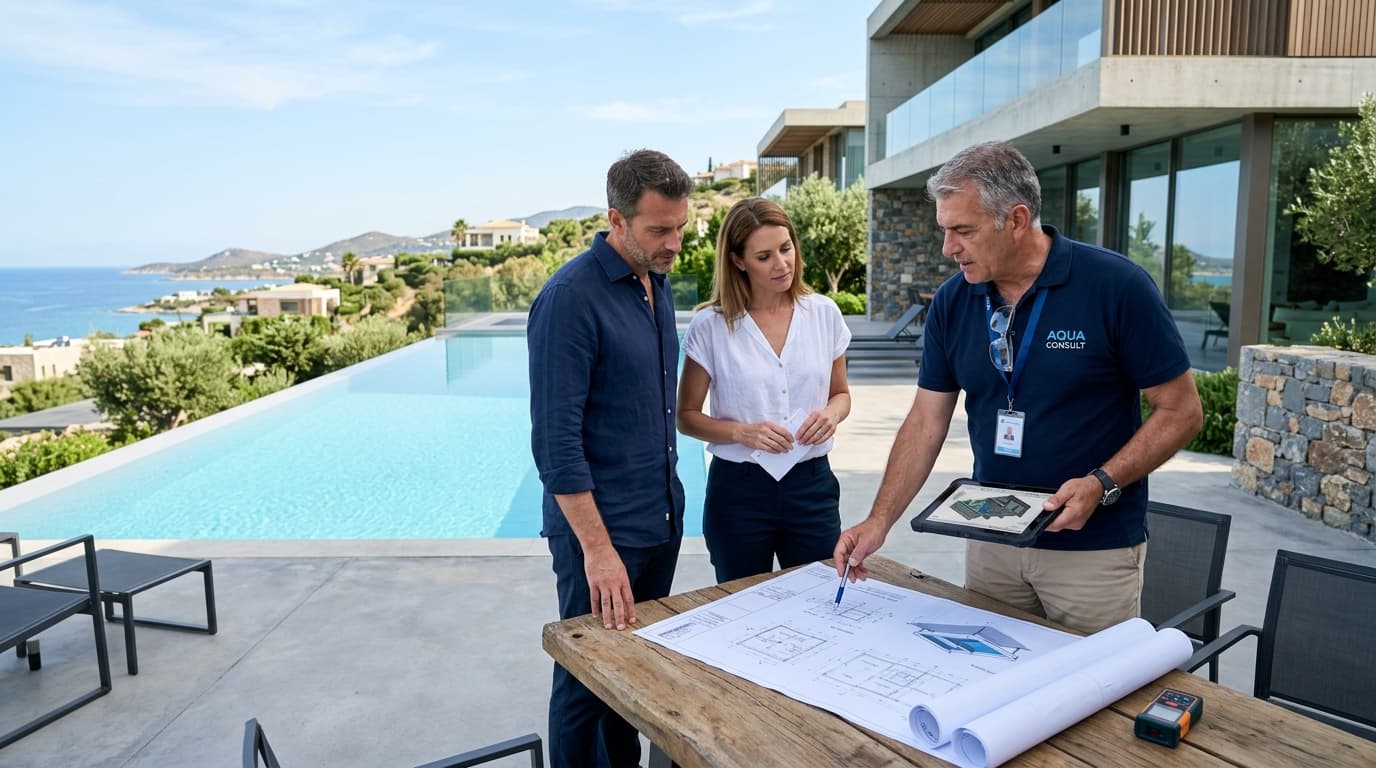
What matters most when choosing a pool construction company?
A reliable pool contractor provides a project-specific hydraulic/structural engineering report, documents compliance with TS 13661 and TS EN 15288, shares ISO certificates transparently, gives a written warranty, and itemizes costs by line. If even one of these five elements is missing, the process carries risk.
Why This Decision Is Hard to Reverse
A swimming pool is a structural, hydraulic, and electrical system buried in the ground and filled with water — once the concrete shell is poured and the piping is embedded, correcting a design mistake means demolition, not a simple repair. This makes the contractor selection decision fundamentally different from choosing, say, a kitchen renovation company.
Yet most comparisons between pool companies focus on subjective signals: years in business, a polished website, or a friendly sales call. This guide sets those aside and lists seven objective, verifiable criteria — the kind you can test with a direct question and a document request, regardless of which company you're talking to.
1Does the Company Provide an Engineering Report & Hydraulic/Structural Calculation?
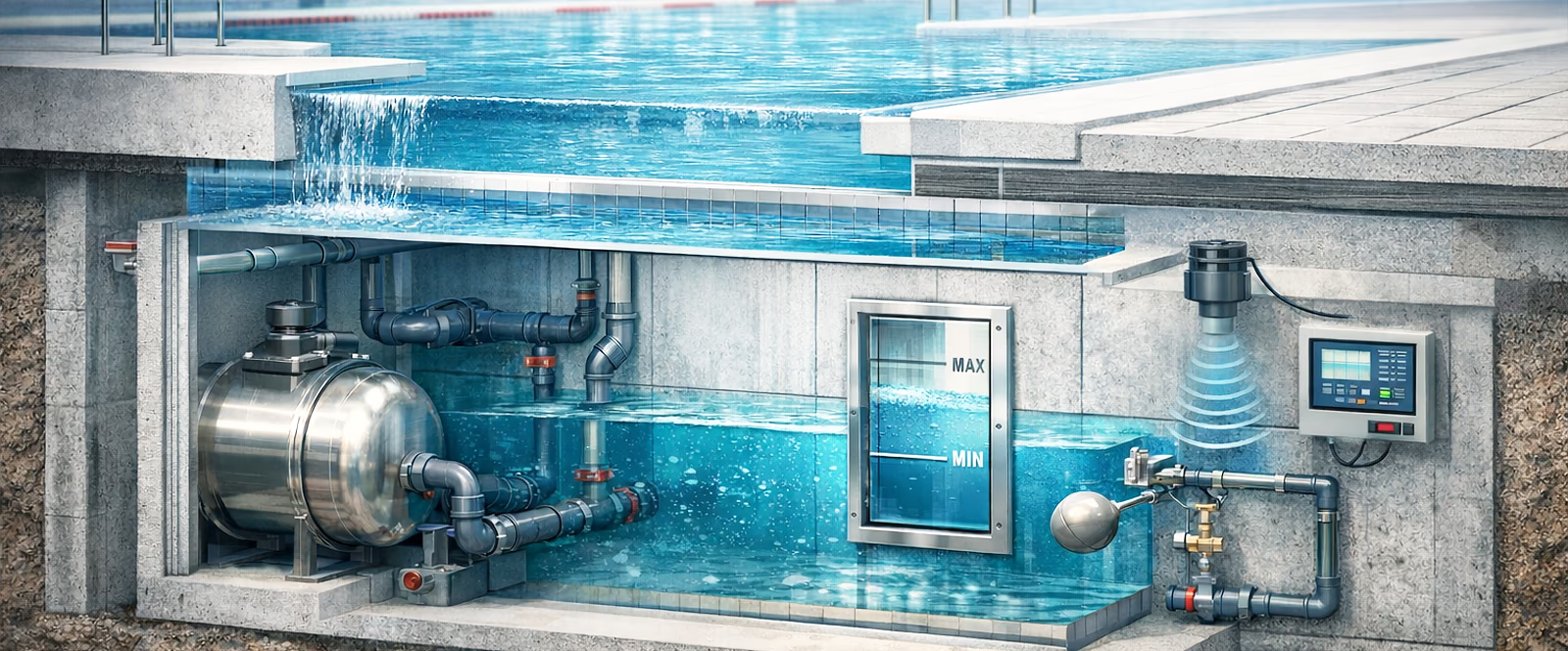
A serious pool contractor should be able to present a project-specific hydraulic calculation (flow rate, turnover time, filtration capacity, surge tank volume) and a structural report (rebar sizing based on soil survey) before the quotation stage. A quote without these documents is essentially a rough estimate based on pool size alone.
The concrete question to ask is: "Which calculation determined my pool's circulation flow rate and surge tank volume?" If the answer doesn't reference a formula, a standard, or a calculation sheet, the process is based on guesswork rather than engineering.
2Is Compliance with TS 13661 and TS EN 15288 Documented?
TS 13661 is the widely recognized European technical standard for pool water treatment and disinfection, defining parameters such as turnover time, filtration rate, and disinfectant levels. TS EN 15288 is the Turkish/European standard governing the design, construction, and operational safety of swimming pools.
Most companies in the sector never reference these standards at all, positioning themselves instead with unmeasurable phrases like "quality materials" or "years of experience." If you ask directly, "What filtration rate and turnover time does my project target under TS 13661?" and receive no concrete numeric answer, standard compliance exists only in the marketing copy.
3Is There Certificate & Document Transparency?
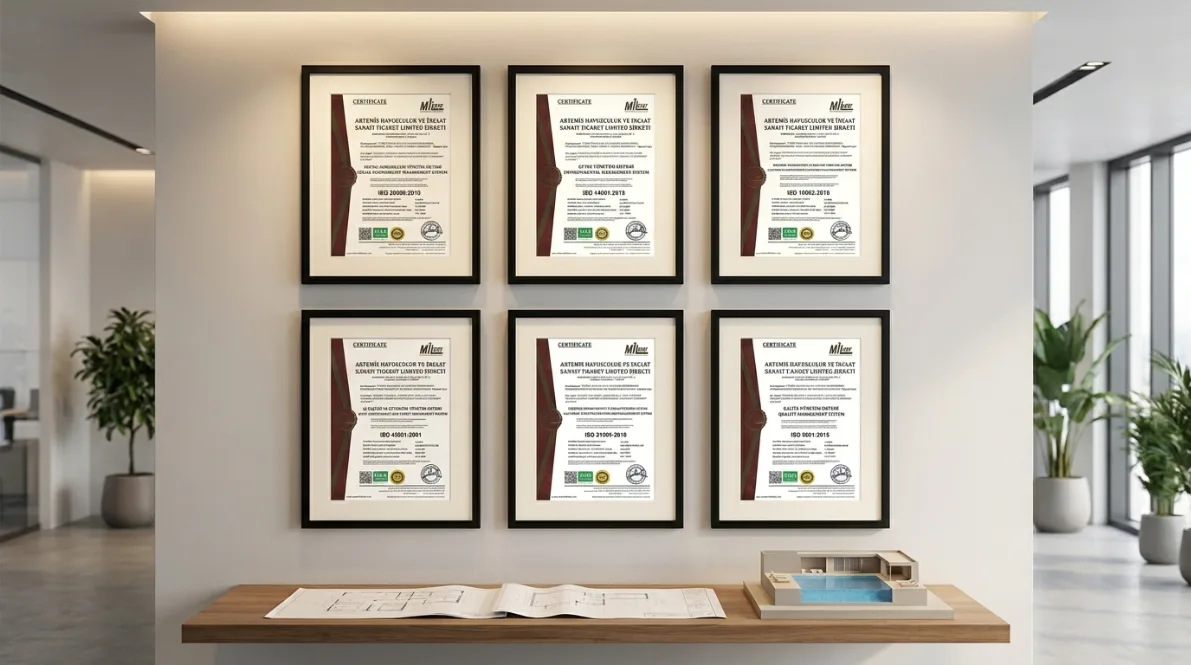
Certifications such as ISO 9001 (quality management), ISO 14001 (environmental management), and ISO 45001 (occupational health & safety) shouldn't be just a logo on a wall — they should be shareable with certificate number, issue date, and scope on request.
Sector scans show that most competitor firms either lack these certifications entirely or leave a "certifications" menu item with no actual content behind it. A company publishing verifiable certificates directly on its website (see Artemis Pool's certifications page) is a far stronger trust signal than a verbal claim.
4Is the Design Process (Design, Structural, Hydraulic, Application) Transparent?
A turnkey pool project requires four distinct engineering disciplines working in sequence: architectural/design project, structural project, hydraulic (mechanical plant) project, and application (execution) project. A trustworthy company can define these four stages separately and show the output of each (drawings, calculation reports, revision history).
When these stages are reduced to a single "we handle everything" sentence, it signals that the design process isn't being run formally. A detailed design process serves as a written reference both during permitting procedures and in the event of a dispute.
5Is the Warranty Scope Written and Clear?
The phrase "it's guaranteed" means nothing on its own. The contract should specify, in writing, separate warranty periods for structural work (concrete shell/waterproofing), mechanical equipment (pump, filtration, heating), and electrical/automation systems, along with exclusions (misuse, lack of maintenance) and the response process (how many business days for intervention).
A quote or contract that omits these details creates ambiguity over who is responsible if a problem arises.
6Are References and the Portfolio Transparent?
Instead of anonymous claims like "thousands of happy customers," reference projects that are named, located, and shared with technical detail (pool type, volume, system used) are a far more reliable signal. Verifiable hotel, villa, or commercial facility references — with project photos and engineering specifications — demonstrate a company's real execution capacity.
A company that can offer an on-site visit to a completed project, or a conversation with the project owner, on request has proven it stands behind its portfolio.
7Does the Quote Include a Cost Breakdown?
Instead of a single-line "total turnkey price," a quote that itemizes excavation/site preparation, the concrete structure, waterproofing, mechanical plant (pump/filtration/heating), electrical/automation, tiling/mosaic, and landscaping separately makes budget planning easier and shows transparently where money is going.
Artemis Pool's Pool Cost & Sizing Report tool helps you evaluate these line items in advance based on your project's technical parameters, giving you a concrete reference point to compare once a quote arrives.
Red Flags to Avoid
The following behaviors, observed at the proposal stage, correlate strongly with disputes and cost overruns later in the project:
10-Question Checklist for Your First Meeting
Bring this list to your first meeting with any pool contractor. A company that answers most of these with specifics — not generalities — is operating on an engineering basis.
- Do you provide a project-specific hydraulic calculation (flow rate, turnover time, surge tank volume)?
- Is the structural project based on an actual soil survey, or is a standard template used?
- Which filtration/turnover parameters are targeted under TS 13661 or TS EN 15288?
- Can you share the certificate number and scope of your ISO certifications?
- Do you deliver the design, structural, hydraulic, and application projects as separate documents?
- Are warranty periods for structural, mechanical, and electrical/automation equipment listed separately in the contract?
- Can I visit a completed reference project on site?
- Does the quote itemize excavation, structure, waterproofing, mechanical, electrical, and landscaping separately?
- Which documents do you provide for the zoning/permitting process?
- Which construction milestones is the payment plan tied to?
Conclusion
None of these seven criteria depend on how a company presents itself — they depend on what it can document. A hydraulic calculation, a structural report, a standard reference, a certificate number, a written warranty clause, a named reference project, and an itemized quote are either produced or they are not.
As Artemis Pool, we run every project through design, structural, hydraulic, and application engineering stages, document our TS 13661 / TS EN 15288 compliance, and share our certificates and reference projects openly — so you can evaluate us against the very checklist above.
Frequently Asked Questions
What is the single most important question to ask a pool company?+
Ask whether they provide a project-specific hydraulic calculation and structural report before quoting. A company that sizes filtration, circulation, and the surge tank through calculation — rather than a rule of thumb — is working as an engineering contractor, not a general builder.
What is TS 13661 and why does it matter?+
TS 13661 is the German/European technical standard governing swimming pool water treatment: turnover time, filtration rate, and disinfectant dosing limits. A company that designs against this standard is targeting measurable, auditable water quality rather than a subjective "looks clean" outcome.
What does the TS EN 15288 standard cover?+
TS EN 15288 covers swimming pool safety requirements across two parts: design/construction (Part 1) and operational safety management (Part 2), including depth markings, slip resistance, hydraulic safety at drains, and signage. It is directly relevant to both private and public pool projects in Turkey.
How can I verify a pool company's certificates?+
Ask for the certificate number, issuing body, and issue date, then verify it through the certification body's own registry rather than taking a logo image at face value. A company confident in its certification will not hesitate to share this information.
How long should the warranty period be on a pool project?+
There is no single legal minimum, but the warranty scope should be written into the contract with separate periods for the structural shell/waterproofing, mechanical equipment, and electrical/automation systems, since each component has a different expected service life and failure mode.
Why does a cost breakdown matter more than a single lump-sum price?+
An itemized quote (excavation, structure, waterproofing, mechanical plant, electrical/automation, finishing, landscaping) lets you compare quotes on equal terms, identify which components drive cost, and avoid disputes later about what was or wasn't included.
Compare Us Against This Same Checklist
Request a hydraulic pre-evaluation, our certificates, and reference projects for your pool project — no obligation.