

Explore our full product range, project applications, and service areas in detail through our E-Catalogue. Our engineering-led solutions and internationally certified services are presented in this comprehensive reference document.
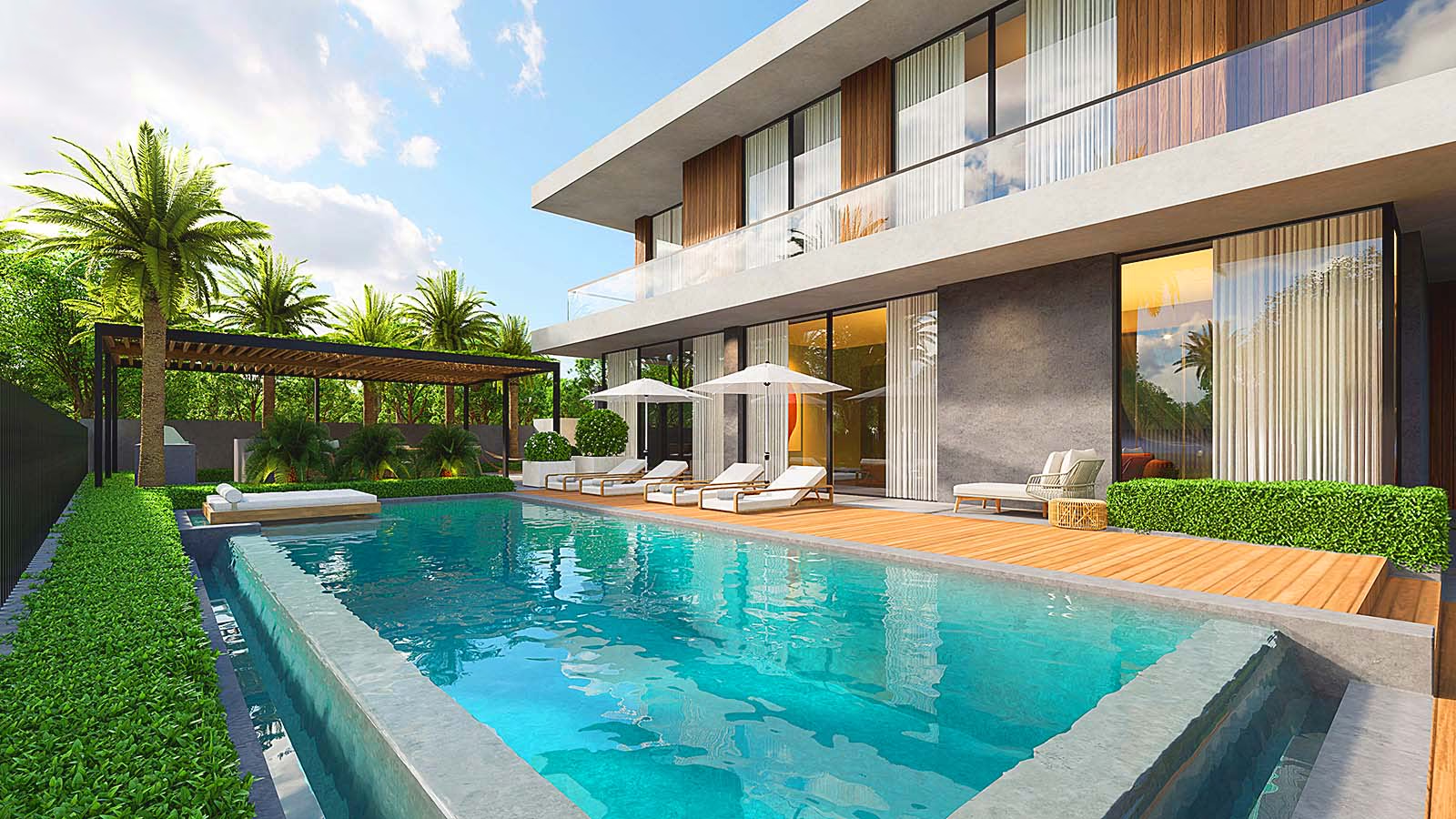
Ornamental pools are not merely a decorative element in architectural projects; they are a versatile design tool that defines a space's identity, its emotional character, and its interaction with the surrounding environment. The reflection of the water surface, changing with the shift of daylight, gives the architectural mass different visual depths at different times; it softens hard structural lines and creates a balance in harmony with nature. The gentle sound of water, calm rippling, and the reflection of light offer the user a peaceful experience both visually and acoustically. In this respect, ornamental pools bring together naturalness, movement, and rhythm in landscape design, increasing the livability of the space. Thanks to the aesthetic bridge it builds between the architectural structure and green spaces, the project is enriched not only functionally but also emotionally. When designed with the right sizing, material selection, lighting, and water-movement concept, ornamental pools give a project prestige, calm, elegance, and a timeless character. In addition, the tranquility of the water makes it easier for people to bond with the space, providing psychological relief as much as aesthetic value.
Architectural reflecting pools and dynamic water features lower ambient microclimate temperatures by 2-4°C through evaporative cooling, generate 45-55 dB white noise that masks urban traffic sounds, and increase residential and commercial property valuation by 10-18% when integrated with stainless steel hydraulics and programmable DMX LED lighting.
Ornamental pools are not just an aesthetic detail in modern architecture; they are a powerful design element that defines a space's identity and forges a visual and emotional bond with its surroundings. The reflection of the water surface, the play of light, the movement of the wind, and the calm sound of water enrich the atmosphere of the building, creating a unity in harmony with nature. When positioned correctly, ornamental pools transform not only the architecture but also the user experience; they bring elegance, tranquility, and prestige to the space, creating a balance that is both functional and emotional.
The trio of “architecture — landscape — water” offers complementary elements when shaping the identity of outdoor space. Let us examine this in three headings.
An ornamental pool can serve as a visual interface in transitional spaces formed with important masses such as a building's entrance facade, foyer area, or recreation area.
Thanks to the reflecting water, glass facades, the sky, trees, and the architectural form visually multiply one another; the architectural mass is thus lightened and harmonized with its surroundings.
At the same time, the water element acts as a balancing agent between the “ground plane” and the “structure”: it helps establish the balance between natural element and built element.
For example, in some contemporary projects the water surface is used as a reflective layer that mitigates heat radiation coming from revolving spaces or building facades.
In landscape design, elements such as movement, sound, and reflection add liveliness to the equation of “static vegetation + hard ground.” Ornamental pools provide this liveliness: water movement, reflection, sound effect.
These elements can be a “quiet centre” or a “dynamic centerpiece” in the landscape; they contribute both to guiding walking paths and to the user experience of the open space.
For example, when a poolside bench or a walking path is positioned facing the water surface, it offers the user a “sitting experience”: the landscape becomes not just a backdrop but a participatory environment.
The sound of water (its babbling, pouring, rippling on the surface) creates a sense of relaxation, meditation, and return to nature in human perception. This is far more than a corridor or an outdoor space that is merely a visual “vantage point.”
An ornamental pool triggers behaviors of “pause” and “observe” in open spaces: for example, an ornamental pool opening onto a building's lobby offers the chance to stop and gaze at the water for two or three minutes; thus the rhythm of the space slows, and the user shifts from “passing through” to “staying” mode.
If an architectural project emphasizes “prestige” or “corporate identity,” the water element reinforces this identity: throughout history, water has carried symbolic meanings such as “cleanliness,” “purity,” and “richness,” and has featured in prestige projects.
Below, I concretely address the benefits frequently mentioned in the literature and in practice. Each heading is supported with references.
Ornamental pools add movement, light, and reflection to the landscape; unlike flat hard surfaces, this gives a feeling of “fluid togetherness” rather than a “rigid stance.”
Furthermore, when placed correctly, it creates an eye-catching detail within the architectural composition: creating a mirror effect with the water surface, using nighttime lighting, and so on.
For example, the reflection an architectural pool makes with a glass facade provides visual continuity between interior and exterior space.
A water element in the landscape functions as a “focal point.” Walking paths, seating areas, and the natural flow direction of the eye can be shaped around this focus.
Within an architectural project, having the pool welcome you as you step in from the entrance, or carrying the reflection of the building facade, reinforces the feeling of “I have arrived at this place.”
In addition, light-and-shadow play can be created around the water element; light directed onto the water is re-reflected onto building surfaces and becomes an active visual element at night as well.
The sound of moving water eases background urban noise; it does not create silence but provides a transition to a balanced “background sound.”
This acoustic layer increases the outdoor space's feeling of “staying.” The user carries the feeling that “I can pause for a few minutes,” not just that of a temporary passage.
Sensorially, too, the water surface responds to movement, light, and reflection effects — this takes the landscape out of being static and engages it in interaction with the user.
Ornamental pools can improve the outdoor microclimate: water evaporation increases ambient humidity; this offers a positive effect particularly in hot, dry climates.
In addition, biodiversity elements such as birds and insects can gather near water — this makes the landscape not just “built for people” but “built for life.”
Consequently, in a sustainable architectural approach, the water element can be seen not as a decoration but as a component connected to the environmental system.
As an aesthetically strong, well-maintained landscape element, an ornamental pool adds value to a project; this value can be measured both perceptually (“prestigious building,” “high-quality outdoor space”) and economically (sale, rental value).
Particularly in corporate or commercial projects, the quality of the outdoor space affects the first impression of a customer or visitor. This is important for brand image and user experience.
“Empty” or “poorly utilized” areas in the landscape (for example on the side facades of a building, at the ends of service roads) can be given function through ornamental pools: they can be visually enriched and turned into areas that offer value to the user.
Moreover, when conditions such as land slope, rainwater direction, and shade-sun exposure are taken into account, the water element can also take on secondary functions such as a “fill” or “drainage element.”
In architectural projects, the water element can support brand identity: for example, monolithic pools reflecting the modern lines of a technology campus, or a dramatic sheet-flow water element at a hotel entrance.
It offers the user not just a building but a “spatial experience”; looking at the water, hearing its sound, experiencing the moment light strikes the water surface… This enables a bond to form with the space.
There are technical and aesthetic criteria to keep in mind when implementing an ornamental pool in architectural projects. Below, I list the important points from the design process through to post-construction operation.
Placement of the pool: Factors such as the user's line of sight, walking axis, and seating point must be kept in mind. For example, the water surface should face the user as they enter the building, or seating areas should orient toward the pool.
Visibility: The pool should be visible from interior spaces (e.g. lobby, restaurant, cafeteria), from exterior spaces, and under nighttime lighting. This ensures day-night continuity.
Lighting: The water surface can be dramatized with light. Lights embedded in the surface accentuate the flow of water; poolside lights create an ambient shadow-light balance.
Material selection: The pool's edge material must be compatible with the movement and reflection of water. Glossy stone and a dark water color make the surface appear deeper, while light-colored stone material can give a lighter expression.
Whether the water will be still or moving must be decided. Still water (a reflecting pool) gives a more serious, minimal effect in architecture, while moving water (waterfall, cascade, flow over gravel) offers a more organic, dynamic feel. Studio Outside Blog
Water depth and color: Deep water surfaces give a calmer, more engaging feeling; they suppress surface movement and provide reflection. That said, environmental factors such as shade and wind conditions must also be evaluated.
Acoustic level: The sound of water movement affects the user experience in the space. An excessively high-flow waterfall can be disturbing to the user; a low, controlled flow may be better.
Pump & circulation system: A pump and filter system of adequate capacity is required for the continuity of the water element. Circulation preserves water quality and prevents algae and bacteria formation.
Waterproofing and joint details: The pool edge and interior must be built with water-resistant materials; risks such as water leakage at joints and slippage of edge stones must be taken into account.
Maintenance plan: Once a water element is added, it requires routine maintenance from an operational standpoint (cleaning, water-level control, pump servicing, winter preparation, etc.). Although sources describe it as “low maintenance compared to other outdoor elements,” this should not be neglected. Eugene Peyzaj+1
Safety and access: Especially in building surroundings used by the public, factors such as water depth, non-slip flooring, and protection against children are important. Some sources cite this as a “safety risk.” Bahler Brothers+1
Climate and local conditions: Environmental conditions such as wind, splash water, shade-light exposure, and leaf fall must be reviewed; for instance, a pool with strong surface movement should not be placed in a very windy area.
The planting around an ornamental pool must create visual unity with the water surface: details such as reflecting plants, trees casting shade over the water, and a stone-to-plant transition at the water's edge should be considered.
In addition, plants and details close to the water contribute ecologically; poolside plants can attract birds and insect species. This increases the environmental value of the landscape.
Walking paths, benches, and seating elements should be planned around the ornamental pool, arranged to face the water surface.
The behavior of the water surface differs at sunset and during nighttime use; under daylight, the reflection and color of the water create one atmosphere, while nighttime lighting creates another. Therefore, “morning, noon, evening” usage scenarios should be considered in advance.
Light spectacle: If budget and concept allow, a “night scene” can be created with details such as LED lights in the water and motion-sensor illumination. However, this increases electrical and maintenance costs; planning must account for this.
The effects of time-varying conditions such as shadows and leaf fall must be calculated: for example, if leaves fall into the water heavily in autumn, maintenance needs can increase.
Across different architectural typologies — such as luxury residential projects, corporate campuses, hotels, and public-space arrangements — ornamental pools become not merely an aesthetic element but also an important component defining the character and mode of use of a space. In each typology, the pool's scale, form, material, and relationship with its surroundings change; sometimes it is a serene reflective surface, sometimes a dynamic focal point, and sometimes a social gathering area, taking on different functions. For this reason, the style, purpose, and mode of interaction with the user of the ornamental pool must be redefined for each project type.
A “reflecting pool” is frequently used in the entrance lobby or at the center of a villa community; the sky or the facade is reflected in the water, giving a sense of expansiveness to the space.
Outdoor seating groups are positioned around the pool: since it offers a relaxation area accompanied by the sound of water, the user experience is elevated.
Dark basalt or black glass ceramic is generally used as the material — this gives the water surface a sense of “infinity.”
Lighting is set up for nighttime use, illuminated either from above or underwater; the morning and evening views are addressed separately.
In a corporate environment, an ornamental pool is an important visual element in terms of “prestige” and “brand image.” It is placed on the entrance plaza, the main road axis, or along sightlines from the main lobby.
The water element can be located in square or rectangular layouts alongside the building's glass facade, and through the reflection effect it enriches both the interior (e.g. meeting rooms) and the exterior visually.
It can also be conceived as a relaxation area where employees take short breaks: it is equipped with benches, planting, and a shade-sun balance along the water's edge.
Technically, it is important for circulation to have low maintenance costs; safety and usage intensity must also be kept in mind.
In areas such as a hotel lobby, terrace floor, or garden floor, the water element can be a “welcoming” and “interactive” feature: dramatic details such as walkways over water, bridges walking through water, or seating areas above water can be considered.
In public squares or urban open-space projects, an ornamental pool — especially pond-light-communication combinations — offers visitors a “photo spot” and a “place for reflection.”
In this type of project, maintenance, safety, and accessibility come to the forefront: heavy usage and diverse user profiles (children, the elderly, people with disabilities) must be taken into account.
To bring a project to life correctly, not only the architect's aesthetic vision but also the landscape architect's spatial framework and the technical expertise of structural-hydraulic engineering teams must work together. These disciplines acting in a coordinated manner from an early stage establishes the right balance among water behavior, the capacity of the structural system, the placement of landscape elements, and user comfort. A successful implementation process offers a sustainable framework, both for design integrity and technical reliability, from the concept stage through to commissioning. Below is a sample implementation model covering the fundamental steps of this process.
User analysis: Who is the project for? Residential, office, hotel? The user profile and usage scenarios are determined.
Site investigation: Land characteristics (topography, groundwater conditions, climate, wind direction), building orientation, and environmental effects are examined.
Concept development: The pool type (reflecting, flowing, waterfall, etc.), placement, scale, and material selection are made. Perspective visuals or 3D renderings are prepared.
Programming: Pool size, depth, circulation system, maintenance requirements, and budget target are determined.
Architecture-landscape integration: Poolside details (railings, seating units, transition paths), the planting plan, and the lighting plan are prepared.
Hydraulic and electrical engineering: Details regarding pump capacity, water circulation, the filter system, electrical connections, lighting, and waterproofing are drafted.
Structural and construction techniques: The pool's structural system, quantity of materials, reinforced concrete/steel reinforcement, ground bearing capacity, and similar factors are evaluated.
Material and planting selection: Edge stones, cladding stones, the water-surface detail (liner or prefabricated cladding), and plant species (suitable for the water's edge, with low leaf fall) are selected.
Coordination: Cross-disciplinary coordination is ensured between architectural cladding, landscape planting, waterproofing, and lighting.
Testing & commissioning: The pump system is run, water circulation is tested, water levels are checked, and lighting is tested.
A cleaning and maintenance schedule is prepared before commissioning.
Routine maintenance: pump filter cleaning, water-level control, water quality (pH, algae, etc.), and surface cleaning.
Seasonal transitions: Especially in cold climates, protection against freezing (draining, winterizing) must be done, and in hot climates, water-loss control must be performed.
User information: The pool surroundings must be made clear for users — seating areas, walking paths, safety warnings.
Monitoring and evaluation: Data such as usage rate, maintenance cost, and the health condition of the landscape must be collected and necessary corrections made.
Every project may not have ideal conditions when starting an ornamental pool application; design mistakes, incorrect material choices, or breakdowns in coordination between disciplines can weaken both the aesthetic and functional quality of a project. While water elements create long-lasting value through correct planning, maintenance, and engineering solutions, even small oversights can negatively affect the system's efficiency and visual impact. For this reason, below are the most commonly encountered mistakes in ornamental pool projects and practical recommended solutions, presented under headings — intended to raise awareness during the design, construction, and operation process.
Mistake: There is not enough visual variety around the pool surface: for example, only a single flat stone, a flat edge, and a single type of plant.
Solution: A “surface transition” should be created at the pool's edge: for example, a water-stone-plant transition; elements such as edge steps, seating units, and shade-providing trees should be added.
Mistake: Very powerful water flow or moving systems such as waterfalls can be disturbing to a user coming from a quiet lobby.
Solution: Flow control should be applied — the water flow rate can be reduced, and surface spread can be wider and at a lower speed. Acoustic testing is recommended.
Mistake: Installation is carried out, but afterward the maintenance plan is not clear; pump systems and filters fall out of service, and the water becomes cloudy.
Solution: A maintenance contract should be prepared; the roles of the architect-landscape team and the maintenance company should be defined; a short “user guide” should be given to the user.
Mistake: The pool is not visible from the user's seating area or vantage point; access is difficult; accessories are missing.
Solution: A user analysis should be conducted: where will the user spend time? How will they see the pool? Is there a walking path? Seating areas should be planned. Shading, lighting, and access comfort should be considered.
Mistake: Environmental factors such as wind direction, shade/leaf fall, and temperature fluctuation have not been considered. For example, a pool placed under a tree with heavy leaf fall increases maintenance needs.
Solution: A microclimate analysis of the site should be conducted; deciduous trees should be kept somewhat away from the pool's edge; wind direction should be evaluated so as not to disturb the movement of the water surface.
The pool's placement and visual axis, its visibility from interior and exterior spaces, the lighting concept, the choice of edge and surface materials, and whether the water is still or moving are the most critical design decisions. In addition, pump/circulation capacity and waterproofing details are decisive from an engineering standpoint.
Architectural reflecting pools and dynamic water features cool the surrounding microclimate by 2-4°C through evaporative cooling. This effect particularly improves outdoor comfort in hot, dry climates.
Moving water generates a natural background sound of 45-55 dB that masks urban traffic noise. This acoustic layer strengthens the user's sense of pausing and lingering in the space.
The pool edge and interior should be applied with dual, fully elastomeric waterproofing materials compliant with TS EN 14891. Joint details must also be evaluated for water leakage and edge-stone slippage risks.
For underwater lighting, IP68-rated waterproof RGBW LED fixtures programmable via the DMX 512 protocol are preferred. These systems dramatize the water surface during nighttime use, adding visual depth to the architectural composition.
Pump and filter cleaning, water quality checks (pH, algae), and surface cleaning should be performed routinely; in addition, freeze protection is required in cold climates during seasonal transitions, while water-loss control is needed in hot climates. Neglecting maintenance directly affects water clarity and system lifespan.
They are applied at different scales and functions: as reflecting pools in luxury residential projects, as prestige and brand-image elements in corporate campuses, as welcoming/interactive features in hotel and resort projects, and as photo and gathering points in public squares.
At Artemis Pool, we offer aesthetic ornamental pool systems, hydraulic infrastructure, and lighting solutions that add value to architectural projects.